
Are GRP water storage tanks suitable for chemical disinfection?
GRP water storage tanks can be suitable for chemical disinfection, but compatibility depends on the tank’s resin or lining, its condition, and the disinfectant concentration, contact time and temperature. Check the manufacturer’s guidance and assess the tank before treatment to avoid surface damage, loss of integrity or contamination of the stored water.
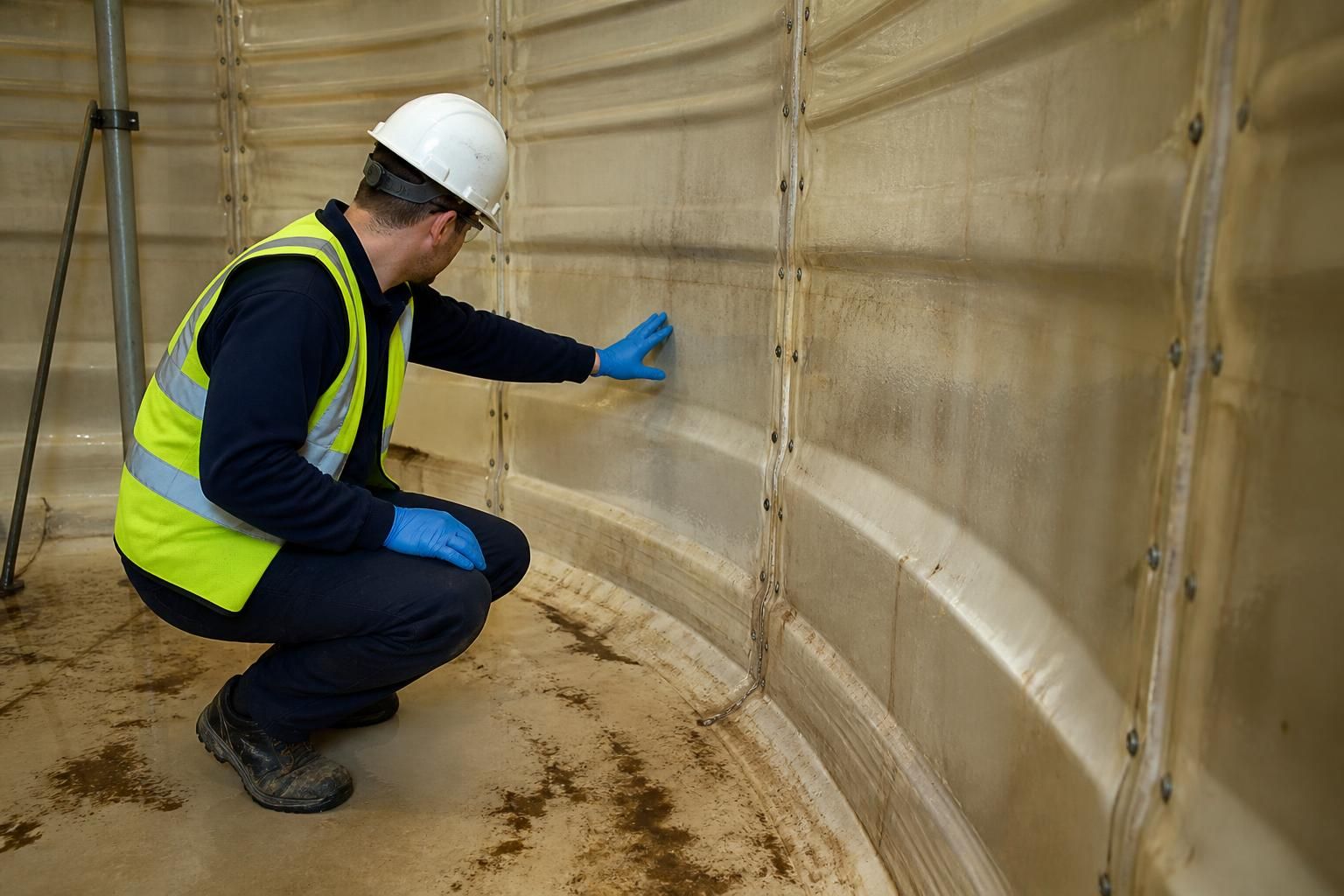
Chemical disinfection is not automatically appropriate for every GRP water storage tank. It should be used only when the tank construction, internal surfaces and connected components have been assessed as compatible with the proposed treatment. A tank may tolerate a controlled disinfection but still be unsuitable for repeated exposure to high chemical concentrations, elevated temperatures or prolonged contact times.
GRP, or glass-reinforced plastic, is made from reinforcing fibres held within a resin matrix. Some tanks also have an internal gel coat or separate potable-water lining. These materials provide different levels of resistance to disinfectants. Compatibility therefore depends on the complete construction, rather than on the term “GRP” alone. The assessment should identify:
- the resin, gel coat or liner used on wetted surfaces;
- whether the tank is approved for the intended water use;
- the proposed disinfectant and its concentration;
- the planned contact time and temperature;
- the age, condition and repair history of the tank; and
- the compatibility of seals, gaskets, valves, pipework and level-control equipment.
The tank manufacturer’s technical information is important because the same chemical can affect different GRP formulations in different ways. Where information is unavailable, the treatment should not be selected by assuming that all GRP products have the same resistance. A competent water hygiene professional may need to obtain construction details, inspect the tank and seek technical confirmation before proceeding.
Potential damage is not always immediately visible. Incompatible treatment may cause softening, swelling, blistering, crazing, discolouration or separation between the resin and reinforcement. Surface deterioration can expose fibres, retain deposits and make subsequent cleaning more difficult. It can also affect the tank’s structural performance. Chemical attack may occur at localised areas such as joints, penetrations, outlets and damaged lining, even where the main tank surface appears sound.
The tank should be inspected before disinfection for cracks, delamination, damaged coatings, staining, sediment, corrosion of associated metalwork and evidence of previous chemical exposure. Visible deposits and sludge may need to be removed first, because disinfectant is less effective where organic matter or biofilm is present. Any defect that could compromise the tank or permit contamination should be addressed as part of the remedial plan rather than concealed by disinfection.
Disinfection should follow a documented method statement based on the confirmed material compatibility and the condition of the installation. It should define the chemical to be used, the dosing method, contact conditions, isolation arrangements, safety controls and disposal requirements. Chemicals must not be mixed unless the procedure specifically permits this and the relevant safety information has been reviewed. Personnel should also consider confined-space hazards, chemical handling and the risk of exposing building users to treated water.
Ancillary components deserve particular attention. Flexible seals, float valves, dosing equipment, sight glasses and non-GRP fittings may have a lower chemical resistance than the tank shell. They should either be confirmed as compatible or protected, removed or replaced where appropriate. The tank should not be returned to service until treated water has been removed or neutralised as required, the system has been thoroughly flushed and there is no unacceptable chemical residual.
After treatment, the installation should be checked for leaks, surface changes and damage to fittings. Water quality testing can help confirm that the system is suitable for recommissioning, particularly where the tank supplies drinking water or is part of a higher-risk commercial installation. The evidence should be retained with the water hygiene records and should include the inspection findings, product or material information, treatment details, measurements, flushing results, test results and any remedial work.
If the manufacturer cannot confirm compatibility, or if the tank is visibly deteriorated, alternative controls may be more appropriate. These could include mechanical cleaning followed by a different validated treatment, replacement of a damaged lining or tank, or changes to the system that address the underlying contamination risk. The decision should be recorded in the site’s legionella control arrangements and supported by a competent risk assessment rather than based solely on the tank’s GRP construction.
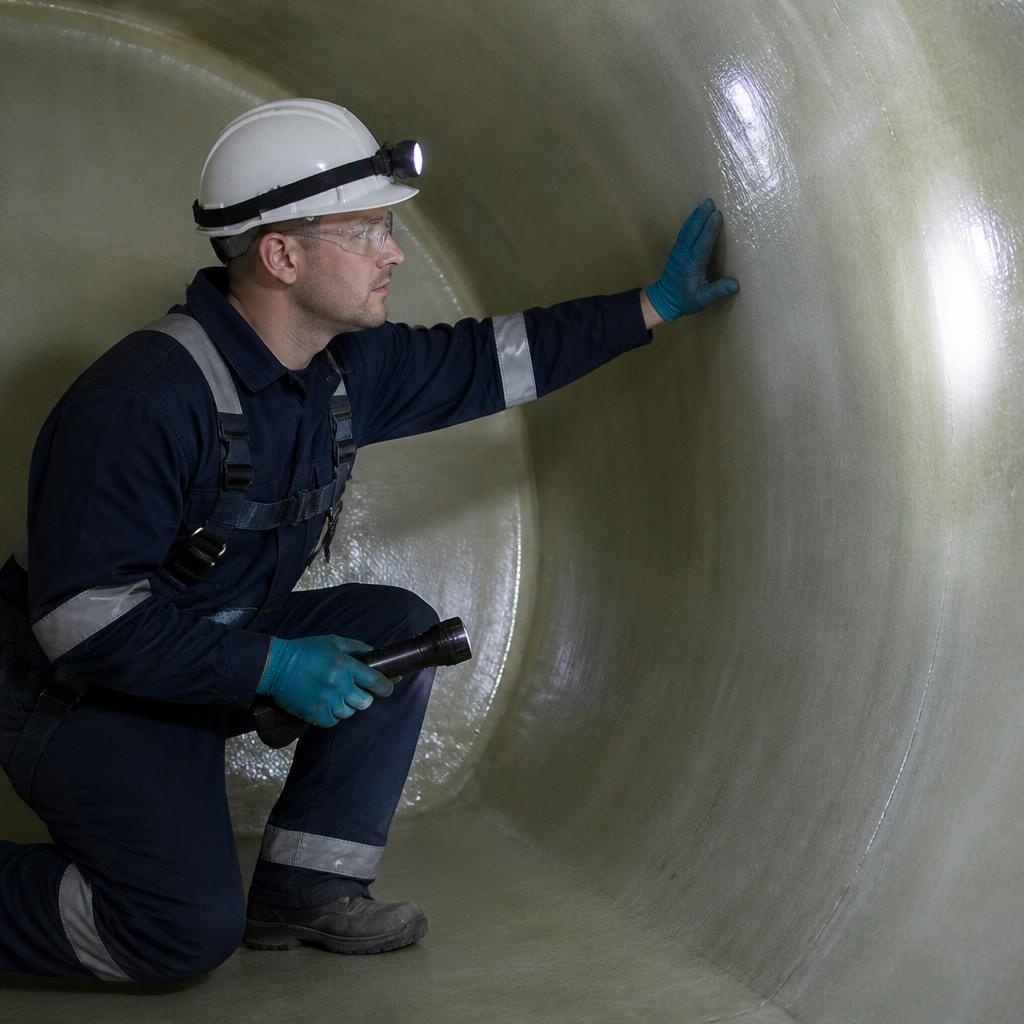
A GRP tank’s approval for contact with drinking water does not, by itself, confirm that it can withstand chemical disinfection. Potable-water approval generally relates to normal service conditions, whereas disinfection may expose the tank to a stronger chemical environment for a defined period. These are separate suitability questions and should be assessed separately.
Before treatment, obtain documentation that addresses both intended water use and resistance to the proposed disinfection method. If the available approval or product literature covers only routine storage, it should not be treated as evidence that the tank is suitable for the planned chemical exposure. This distinction is particularly important when deciding whether a tank can be disinfected repeatedly as part of an ongoing water hygiene programme.
Request a GRP tank disinfection assessment
If the tank’s construction records do not clearly support the proposed treatment, request a GRP tank disinfection assessment to review the available evidence and determine an appropriate next step.