
Which sampling points should potable water chlorine monitoring cover?
Potable water chlorine monitoring should cover representative points across the system, including the incoming supply, outlets after storage or treatment, and representative hot and cold water outlets. Include distal, low-use and higher-risk outlets where chlorine loss, stagnation or changes in water quality may be more likely, with the selection documented in the water safety plan.

Potable water chlorine monitoring should use a documented, risk-based set of sampling points that shows how disinfectant residual changes from the point of supply through to the most vulnerable parts of the building. The programme should include points that represent the main water pathways, locations where chlorine may be consumed or diluted, and outlets where deterioration in water quality would have the greatest consequence.
Start with the supply entry point. A sample taken where water enters the premises provides a reference result for the incoming supply. Where a site has more than one incoming main, separate supplies, or distinct water systems, each relevant entry point should be considered. This helps distinguish a change originating in the incoming water from a change caused by storage, treatment or distribution within the premises.
Sample around storage and treatment equipment. Where water passes through tanks, break tanks, booster arrangements, filters, softeners, dosing equipment or other treatment processes, points before and after the relevant equipment may be needed. The exact selection depends on whether the equipment can affect chlorine concentration, introduce stagnation, or divide the system into separate branches. If several tanks or treatment trains operate independently, a single result may not represent all of them.
- At the inlet and outlet of significant storage vessels where the stored water may have a different residual from the incoming supply.
- Downstream of treatment that can remove, consume or alter chlorine.
- On separate branches supplied by different tanks, pumps or treatment arrangements.
- At the start of long distribution runs where water may spend longer in the pipework before reaching an outlet.
Use outlets to represent the distribution network. Sampling should not be limited to convenient taps close to the plant room. Select outlets that represent the main branches, floors, wings, departments or occupancy areas. A sampling point near the beginning of a branch may show that water is leaving the plant in an acceptable condition, while a point farther along the same branch can indicate whether the residual is being maintained through the distribution system.
Particular attention is appropriate for outlets with low or intermittent use, long pipe runs, dead legs, oversized pipework or a history of stagnation. Include points where pipe temperatures, blending arrangements or local system conditions could contribute to loss of disinfectant. An outlet used by vulnerable occupants, or one serving a high-consequence area, may warrant inclusion even when it is not the most distal point hydraulically.
Consider hot and cold water separately. Cold-water points are generally the clearest indicator of residual chlorine within the potable distribution system. Hot-water outlets can still be relevant where the risk assessment requires them, but results should be interpreted in the context of the hot-water system, including storage, recirculation, blending valves and the effect of heating. A hot-water result should not automatically be treated as interchangeable with a cold-water result from the same room or branch.
Choose points that can be sampled consistently. The outlet should be accessible, identifiable and suitable for obtaining a representative sample without contamination from removable fittings or local devices. Taps fitted with filters, hoses, spray heads or other attachments may not reflect the wider system unless their effect is specifically part of the assessment. Where such an outlet is operationally important, it can be monitored alongside a nearby point that represents the incoming branch.
Sampling method matters as much as location. The procedure should state whether the sample is taken as a first-draw sample or after a defined flush, and that approach should be applied consistently. Record the point identity, date, time, water temperature where relevant, sampling condition and any unusual circumstances such as recent maintenance, low occupancy or abnormal demand. Results from differently collected samples should not be compared without considering those differences.
A useful sampling schedule normally combines:
- Reference points that show the condition of water entering the premises or a defined water system.
- Control points after storage, treatment or other infrastructure that may change the residual.
- Distribution points from representative branches and areas of the building.
- Risk points selected because of stagnation, complexity, vulnerable users, previous findings or the consequences of a deterioration in water quality.
- Investigative points added temporarily to trace a result that differs from nearby locations.
The selected points should be shown on a current schematic or sampling plan, with a short reason for including each one. The plan should identify the outlet or asset precisely rather than using descriptions such as “first-floor tap” that could be ambiguous. It should also show points that are no longer representative because of alterations, isolation, refurbishment or changes in occupancy.
Review the selection whenever the water system changes, a tank or treatment unit is modified, building use changes, monitoring identifies a recurring low residual, or an investigation finds a difference between nearby outlets. Sampling points should also be reviewed if they are repeatedly inaccessible or rarely used in the way assumed by the risk assessment. The aim is not to test every outlet routinely, but to maintain enough well-chosen points to explain the behaviour of the system and identify where further investigation is justified.
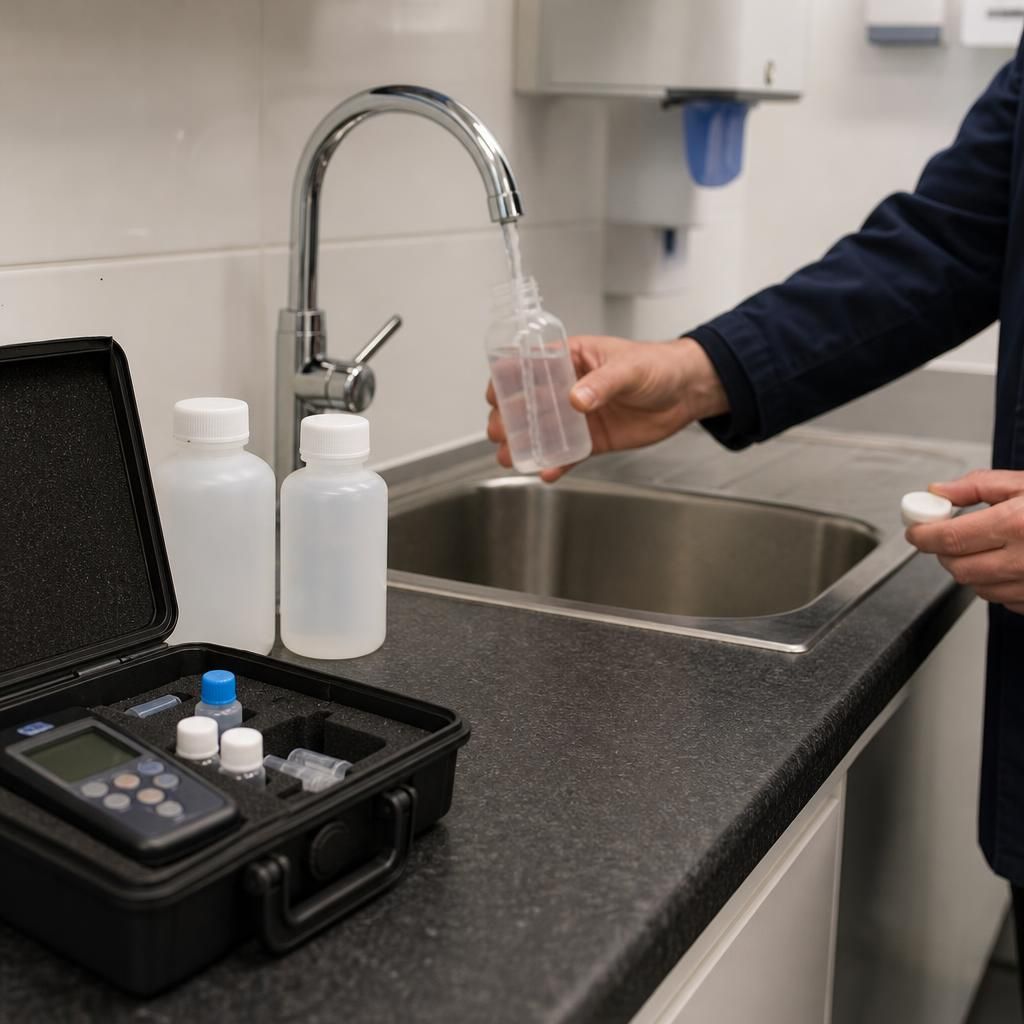
A supply-entry result cannot be used as a substitute for point-of-use sampling. Chlorine residual may change as water passes through storage, treatment equipment and distribution pipework, so a satisfactory incoming result does not demonstrate that every occupied area receives water with the expected residual.
For this reason, the sampling plan should link each control point to the part of the system it represents. If a downstream result differs from the entry-point result, the comparison helps identify whether the change is associated with storage, treatment or distribution. This makes the sampling programme more useful for deciding where targeted investigation or remedial action is needed.
Need help selecting potable water chlorine sampling points?
If you need to validate your sampling plan, speak to Blue Fish Water Management about a risk-based review of your potable water chlorine monitoring arrangements.