
How should abnormal potable water chlorine results be investigated?
Investigate abnormal potable water chlorine results by first confirming the sample, test method and sampling conditions, then assessing the result against recent trends and the monitoring programme’s action levels. A competent person should identify likely causes, inspect relevant parts of the water system, record the findings, implement proportionate corrective action and verify the outcome through follow-up testing.
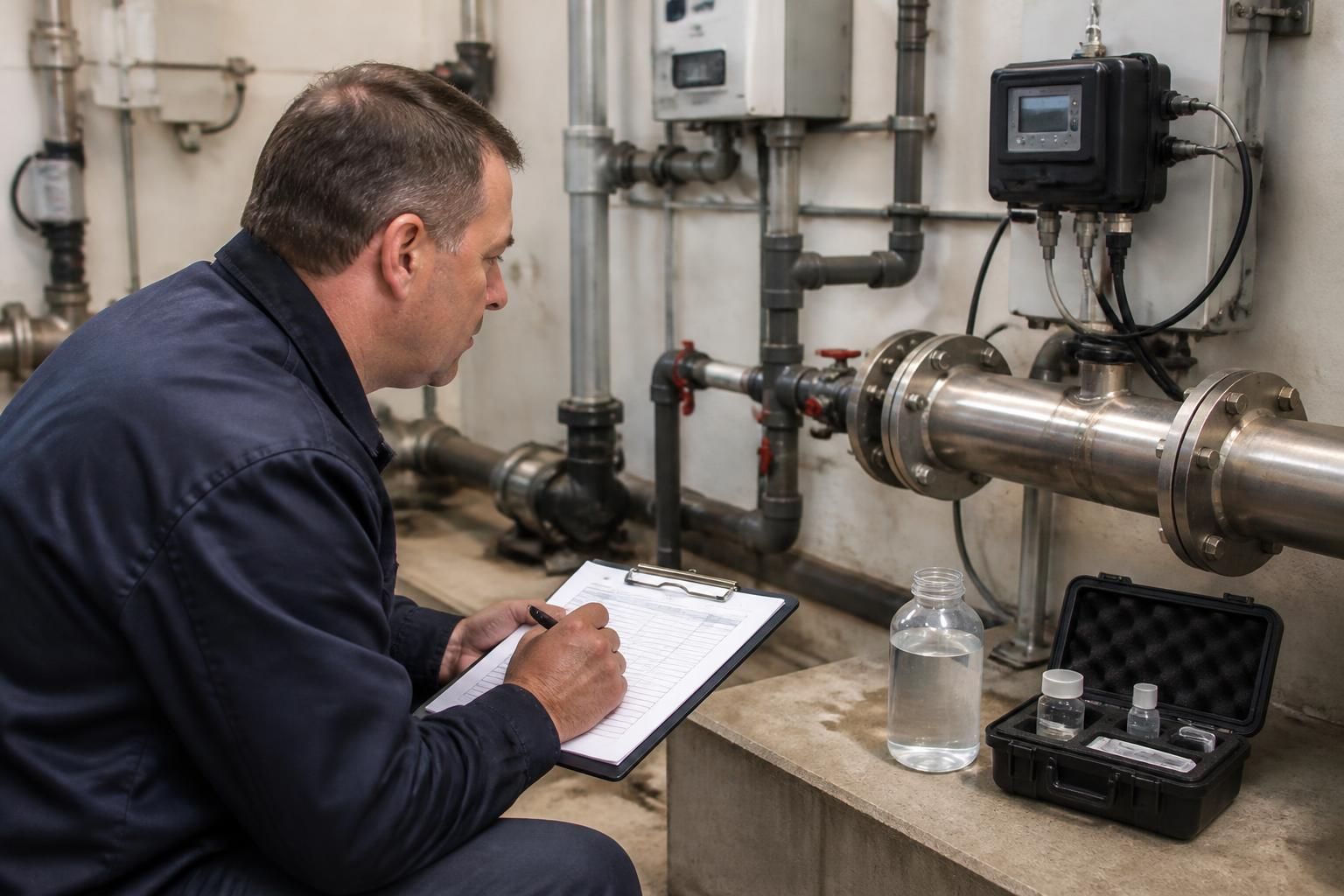
An abnormal potable water chlorine result is a deviation from the monitoring programme’s expected range or action level. It should be investigated as a potential indication of a sampling error, dosing problem, water-quality change or loss of control within the distribution system, rather than treated as an isolated number without context.
The investigation should establish four points: whether the result is reliable, where the change occurred, what may have caused it and whether people could be exposed to an unacceptable water-quality risk. The response should be proportionate to the result, the type of system and the consequences of using the affected water.
Start by checking the result itself
- Confirm whether the result relates to free chlorine, total chlorine or another disinfectant measurement. These values are not interchangeable.
- Check the sample identification, collection point, date, time, sampler and test method.
- Review the instrument or test kit condition, reagent expiry, calibration or verification records and any observations made during testing.
- Consider whether the sample was taken after flushing, from a stagnant outlet, immediately after maintenance or under unusual operational conditions.
- Check whether the sample was tested within the method’s required period and whether it was exposed to heat, light or contamination before analysis.
A repeat test can help distinguish a genuine change from an analytical or sampling anomaly, but it should be taken using a controlled method. Simply repeating the same procedure at the same outlet may reproduce the original error. Where the result has significant implications, an independent laboratory test or competent technical review may be appropriate.
Compare the result with useful context
Review recent results from the same point and from nearby upstream and downstream points. A single low reading at one outlet may indicate local stagnation or a contaminated fitting, whereas a similar change throughout the system may point to a dosing, supply or storage issue. A high reading may also be local, for example following a dosing adjustment or incomplete flushing, or may affect the wider system.
Relevant information to review includes:
- Recent chlorine results and any developing trend.
- Results from the incoming supply, storage tanks, treatment equipment and representative outlets.
- Changes in occupancy, demand, water turnover or periods of low use.
- Plant alarms, dosing records, chemical deliveries, pump operation and control settings.
- Recent cleaning, disinfection, plumbing alterations, shutdowns or recommissioning.
- Water temperature, appearance, odour and any reports of taste or other unusual conditions.
The result should be assessed against the limits and actions defined for that particular water system. A value that is unusual but within the programme’s control range may require closer observation, while a result outside an action level may require immediate operational controls and escalation.
Investigate likely causes of a low result
Low chlorine can arise because disinfectant has been consumed, diluted, lost during storage or failed to reach the sampling point. Possible causes include excessive water age, low turnover, dead legs, poorly managed storage, biofilm or organic demand, a dosing pump fault, an empty chemical container, incorrect calibration, a blocked injection point or an interruption to the incoming supply. A low result may also reflect an outlet that was not flushed consistently before sampling.
Trace the system from the point of entry towards the affected outlet. Check tank condition, inlet and outlet arrangements, circulation or recirculation, pipework dead ends, valves and any treatment equipment. Where several points show reduced residuals, examine common upstream components before focusing on an individual outlet.
Investigate likely causes of a high result
High chlorine can result from excessive dosing, a control fault, incorrect chemical strength, poor mixing, a recent shock treatment or a sample taken before the system had returned to its normal operating condition. Confirm the chemical specification and dosing settings, inspect injection and mixing arrangements, and establish whether an automated controller is receiving reliable readings.
Do not dilute, discard or return affected water to service without a documented assessment. Depending on the circumstances, the responsible person may need to isolate an affected section, suspend use for an appropriate purpose, flush under controlled conditions or obtain specialist advice. Any action should consider the possible impact on users, equipment and the wider water system.
Assess whether other hazards may be present
Chlorine is an important control indicator, but it is not a complete assessment of potable water safety. An abnormal result should be considered alongside temperature, system condition, storage hygiene, turbidity, microbiological findings and any relevant changes in the supply. Where the result suggests a loss of disinfection control or contamination, additional sampling may be needed to establish the extent and significance of the problem.
Microbiological sampling should be selected by a competent person and interpreted in relation to the system, sample locations and investigation findings. It should not be used as a reason to delay sensible control measures where there is already evidence of a significant problem.
Define and verify corrective action
Corrective action should address the identified cause rather than only improve the next test result. Examples may include repairing dosing equipment, correcting controller settings, replenishing or replacing chemicals, cleaning and inspecting a storage tank, removing redundant pipework, improving turnover, flushing a defined section or revising the sampling method.
After action is taken, verify that:
- The original cause has been corrected or adequately controlled.
- Results at the affected point have returned to the programme’s expected range.
- Upstream and downstream points do not show an unresolved change.
- Any associated microbiological or water-quality concerns have been addressed.
- Monitoring frequency and action levels remain suitable for the system.
Further investigation is required if results remain abnormal, fluctuate repeatedly or disagree with results from other points. Recurring deviations may indicate a poorly positioned sampling point, inadequate turnover, unreliable equipment, an unrecognised design defect or a control programme that does not reflect how the system is operated.
The completed investigation should show the original result, validation checks, system observations, relevant trends, risk assessment, decisions, corrective actions, responsible persons and verification results. This provides an auditable explanation of why the result was treated as an error, a local defect or a wider control failure, and supports review of the potable water monitoring programme by the competent person.
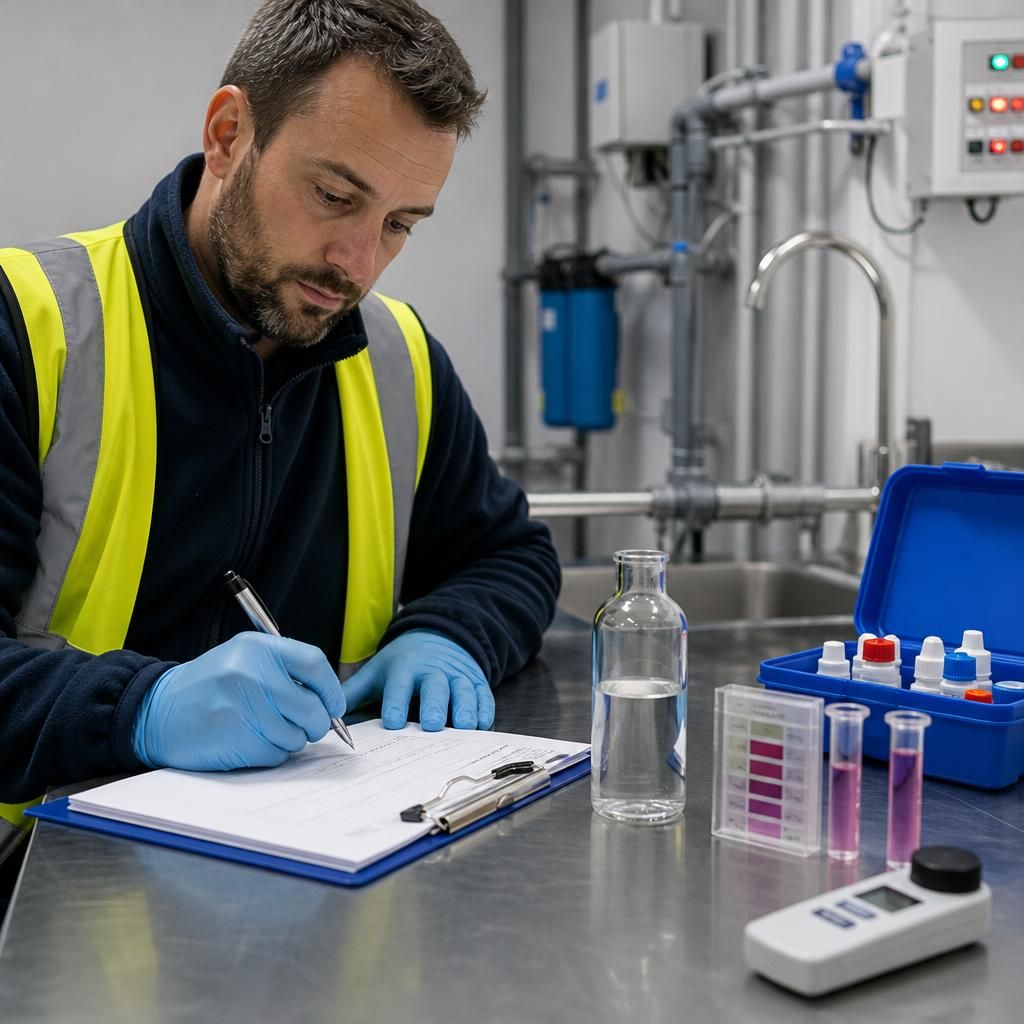
The distribution of abnormal results helps determine whether the issue is internal or associated with the incoming supply. If the change is present at the point of entry and continues across multiple parts of the premises, the responsible person should check supply conditions and contact the relevant water supplier where appropriate. If the point of entry is normal but storage tanks, treatment equipment or downstream outlets are affected, the investigation should concentrate on the internal system.
Record the basis for any escalation, including the affected locations, test results, operational changes and measures taken to control use. This gives the water supplier, specialist adviser or other responsible parties enough information to assess the issue without relying on an isolated chlorine reading.
Discuss an Abnormal Potable Water Chlorine Result
If an abnormal potable water chlorine result needs independent technical review, discuss the findings with Blue Fish Water Management. Their team can help assess the evidence and determine whether further investigation or corrective action is appropriate.