
Who remains responsible after appointing a pool chlorination provider?
Appointing a pool chlorination provider does not remove the duty holder’s legal responsibility for managing risks to pool users and maintaining safe water systems. The responsible person must select a competent provider, define the agreed work clearly, review results, act on recommendations and retain effective oversight of compliance.
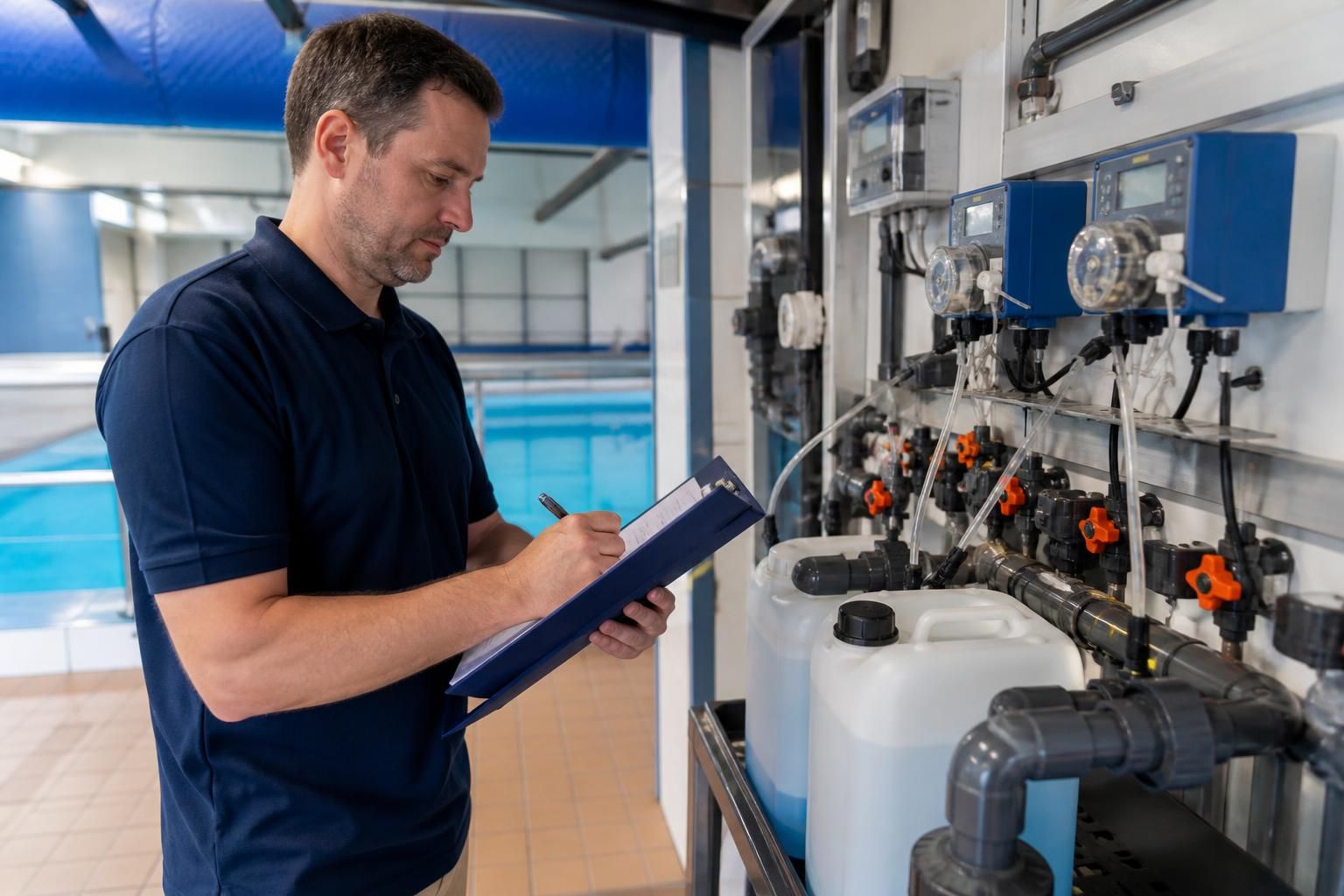
The duty holder remains legally responsible for pool safety after appointing a chlorination provider. Depending on the premises and operating arrangements, this may be the employer, pool operator, occupier, landlord, facilities manager or another organisation with control over the water system and users. Several parties can hold duties at the same time, and a service contract does not automatically transfer those duties to the contractor.
What the provider is responsible for
A chlorination provider is responsible for carrying out the tasks it has accepted to perform with suitable competence and care. This may include chemical dosing, water testing, plant checks, cleaning, sampling, reporting and advising on corrective action. Its responsibilities should be identifiable from the contract, method statements, risk assessments, test records and reports.
If a provider makes an error in its own work, fails to follow an agreed procedure or gives unsuitable advice, it may have contractual or other legal exposure. That does not, however, remove the pool operator's separate responsibility to manage the premises safely. The operator cannot assume that a contractor's involvement makes every aspect of the pool compliant.
What remains with the pool operator
The organisation controlling the pool normally remains responsible for the wider management system. This includes ensuring that:
- the pool's risks have been assessed in relation to its design, use, users and water-treatment arrangements;
- staff understand the operating controls and know how to respond to abnormal readings, plant failures and contamination incidents;
- chemicals are stored, handled and supervised safely;
- the filtration, circulation, heating, ventilation and dosing equipment is maintained and used correctly;
- the provider's reports are considered by someone with authority and technical understanding;
- faults, failed tests and overdue remedial actions are recorded and managed; and
- the pool is restricted or closed where conditions create an unacceptable risk.
These responsibilities matter because chlorination is only one part of water safety. Free chlorine readings can be affected by pH, bather load, water temperature, circulation, filtration, combined chlorine and the condition of the plant. A pool may therefore need action even where a single chlorine result appears satisfactory.
Delegating work is not the same as delegating accountability
A business can delegate operational tasks to a competent contractor, but it still needs sufficient knowledge and oversight to confirm that those tasks are being completed as intended. The responsible organisation should know what the provider does not cover. For example, a chlorination contract may exclude mechanical maintenance, filter cleaning, microbiological investigations, emergency response, staff training or water-system remedial work.
Those exclusions should be understood before an incident occurs. Responsibility for an excluded activity usually remains with the organisation controlling the pool, unless another suitably appointed party has expressly accepted it. Vague wording such as “pool maintenance” may create uncertainty about who checks dosing equipment, authorises plant isolation, investigates failed samples or contacts emergency services.
Relevant duties and guidance
UK pool operators may have duties under general health and safety legislation, including the Health and Safety at Work etc. Act 1974 and the Management of Health and Safety at Work Regulations. Where hazardous treatment chemicals are used, the Control of Substances Hazardous to Health Regulations and applicable chemical-storage requirements may also be relevant. The precise duties depend on the premises, workforce, system and activities taking place.
Guidance such as the Health and Safety Executive's swimming-pool guidance, legionella guidance where the system creates a relevant exposure risk, and industry water-treatment guidance can help operators establish suitable controls. Guidance is not a substitute for assessing the particular pool. A spa pool, hydrotherapy pool, school pool, leisure facility and private residential pool can present different hazards and require different arrangements.
Multiple duty holders must cooperate
Responsibility can be shared between a landlord, managing agent, employer, leisure operator, maintenance contractor and specialist water-treatment company. Each party should understand its own control over the premises, plant, staff and users. Where duties overlap, the parties should exchange relevant information and coordinate their procedures rather than assume that another organisation is dealing with the risk.
For example, a landlord may control the building and fixed services, while an operator controls opening the pool, supervising users and responding to water-quality results. A chlorination provider may control dosing checks and sampling, but may not control access to plant rooms or the decision to close the pool. Written arrangements should reflect those practical lines of control.
Records help demonstrate effective control
The responsible organisation should retain appropriate evidence of how the pool is managed. Depending on the risk assessment, this may include chemical and water-quality logs, calibration records, maintenance reports, laboratory results, incident records, staff training records, contractor reports and evidence that faults were resolved.
Records are not merely paperwork. They allow the operator to identify trends, such as repeated pH instability, increasing combined chlorine, recurring microbiological results or dosing interruptions. They also show whether recommendations were evaluated and whether decisions were made by someone able to assess the risk.
What to establish before appointing a provider
The operator should identify the legal duty holders and set out the provider's role in operational terms. Useful questions include:
- Which systems, equipment and sampling points are included?
- Which parameters will be checked, and how will results be reported?
- Who investigates an out-of-range result or failed microbiological sample?
- Who can authorise isolation, corrective work or closure of the pool?
- Which person receives urgent findings and tracks them to completion?
- What training and competency evidence does the provider maintain?
- Which tasks remain with the operator or another contractor?
Ultimately, appointing a provider can give the duty holder specialist support, but it does not remove the need for informed management decisions. The organisation that controls the pool must continue to understand the risks, maintain suitable arrangements and ensure that advice and test results lead to appropriate action.

Responsibility usually remains with the organisation, not simply the named individual. A business may appoint a pool manager or responsible person to coordinate chlorination records, contractor communication and corrective actions, but naming that person does not normally make them the sole legal duty holder. The organisation must give them suitable authority, resources and competence to carry out the role effectively.
This distinction matters if the appointed person cannot obtain repairs, restrict pool use or escalate unsafe conditions. The organisation should define who can make those decisions and provide a clear substitute when the usual contact is unavailable. A provider’s appointment should therefore be recorded as part of the pool’s governance arrangements, alongside the authority given to internal personnel and the circumstances requiring management intervention.
Review Your Pool Chlorination Responsibilities
Arrange a review of your pool chlorination arrangements with Blue Fish Water Management Ltd to clarify responsibilities, contract boundaries and required records.