
What records should mains chlorination provide?
Mains chlorination records should provide a clear audit trail of the disinfection work, including the water main or section treated, the chlorination method, dates, test results and any relevant observations. The completed record should normally be accompanied by a certificate confirming whether the main met the required water quality criteria for commissioning.

Mains chlorination records should form a complete commissioning pack, not just a certificate. They should allow the client, water company or auditor to identify what was disinfected, verify that the required checks were completed, and confirm that the results support safe connection or use of the new main.
A properly prepared record pack will usually include the following information:
- Asset identification: the development, site address, main reference, pipe section, diameter, material, approximate length and any associated fittings, storage tanks or branches included in the work.
- Scope and method: the disinfection procedure used, including how the main was isolated, filled, dosed, circulated or left in contact, flushed and returned to service. Any relevant calculation or dosing information should be retained where it supports the work carried out.
- Sampling details: the locations from which samples were taken, the sample identifiers, the person who took them and the conditions at the time. Sampling points should be identifiable on a drawing or marked-up plan where the layout is complex.
- Water quality results: records of the relevant chemical and microbiological tests, including the measured results, units, acceptance criteria and the laboratory or analyst responsible. Where samples are sent to a laboratory, the report should show the sample references and preserve the link between each result and the corresponding main.
- Flushing and observations: notes on the water’s appearance, odour or other unusual observations, together with details of flushing, restrictions, interruptions or access issues that affected the procedure.
- Exceptions and corrective action: any failed or inconclusive result, retest, additional flushing, repeat disinfection or other remedial work. The record should make clear what changed before the final sample was taken, rather than presenting only the final satisfactory result.
- People and approvals: the names or roles of the contractor, sampler, reviewer and person authorising the main for commissioning, along with relevant dates and signatures where the project’s quality procedures require them.
The certificate is the formal summary of the outcome. It should identify the relevant main and state whether the disinfection and testing requirements were met. It should not be treated as a substitute for the supporting laboratory report, sampling information and treatment record. If a certificate is provided without the underlying evidence, it may be difficult to demonstrate exactly how the conclusion was reached.
Records should also show the relationship between different parts of a phased project. For example, if a main was divided into sections, each section should be traceable to its own treatment and test results. A site plan, marked-up drawing or schedule can prevent uncertainty about whether valves, hydrants, branches and temporary connections were included or excluded.
Before accepting the pack, the client or project manager should check that:
- the asset description agrees with the construction or commissioning information;
- sample references match the laboratory results;
- the recorded results are clearly compared with the applicable acceptance requirements;
- any unsatisfactory result has a documented follow-up action and outcome;
- the certificate is signed or authorised by the responsible party; and
- the final documents are filed with the site’s water-system and handover records.
These records should be retained with the operation and maintenance information for the water system. They may be needed later when investigating a water quality issue, carrying out alterations, demonstrating commissioning history or reviewing whether a section can be safely brought back into service. A clear, traceable record is therefore useful both as evidence of the original work and as part of the main’s ongoing compliance history.
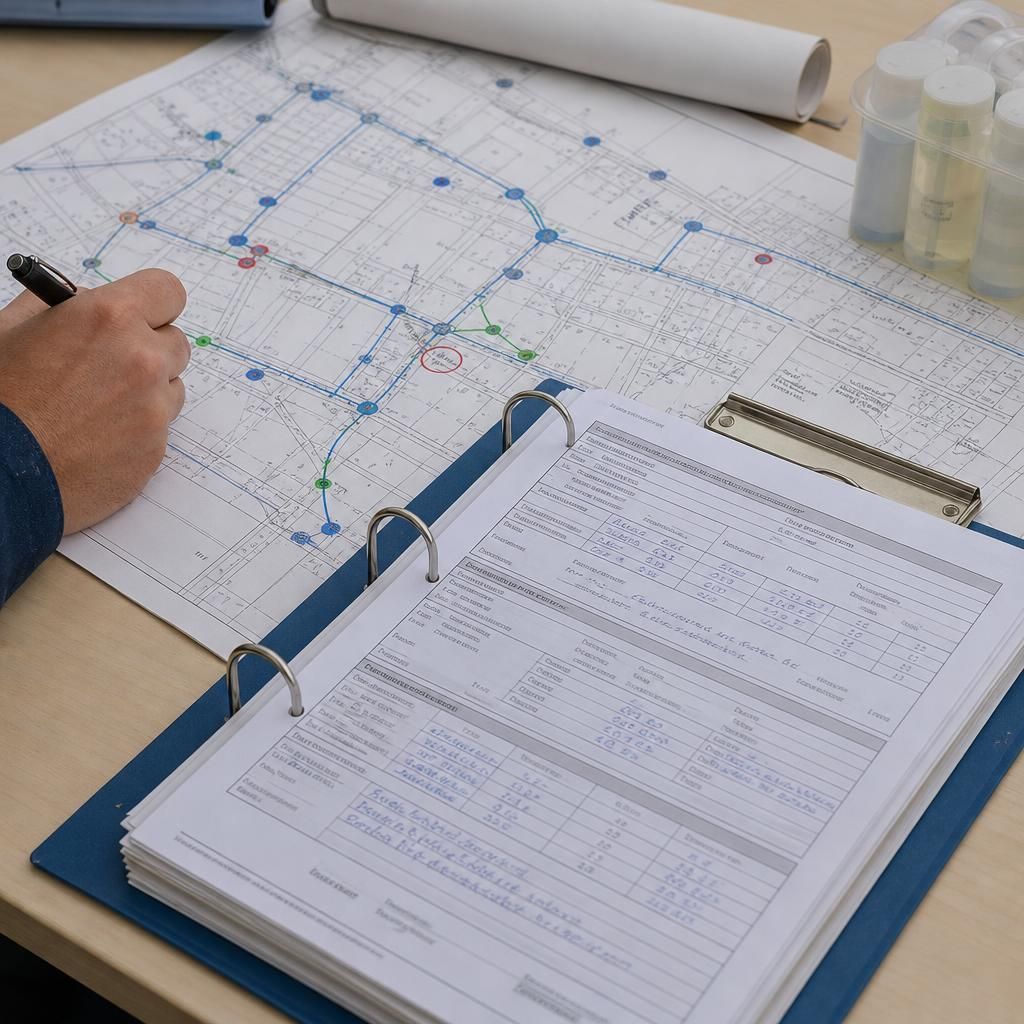
Where chlorination or testing is repeated, the record should preserve the full sequence rather than show only the final satisfactory result. Keep the original test report, the reason for further work, details of the additional treatment or flushing, and the subsequent result together in chronological order.
This document control makes it clear which evidence relates to each stage of commissioning and prevents earlier results being mistaken for the final outcome. Any amended entry should remain readable, dated and attributable to the person making the change.
Need Help With Mains Chlorination Records?
Speak to Blue Fish Water Management about the documentation needed for your mains chlorination project and how to organise a clear commissioning record.