
What maintenance schedule will apply to the chlorine filters and associated equipment?

A suitable maintenance schedule is a documented, risk-based programme that sets out who will inspect, service, clean, test and replace each part of the chlorine filtration arrangement. The interval for each task should be determined by the system design, water quality, flow demand, operating hours, manufacturer’s instructions and previous inspection results, rather than applying the same timetable to every installation.
Routine operator checks
The day-to-day or regular operator checks should be simple, consistent and recorded. They may include looking for leaks, unusual noise, vibration, corrosion, damaged pipework, abnormal pressure readings, control-panel alarms and changes in treated-water appearance or odour. Operators should also confirm that valves are in their intended positions and that the equipment has not been bypassed inadvertently.
Where the system has gauges or sensors, readings should be compared with the normal operating range established during commissioning. A gradual change can indicate fouling, a blocked cartridge, exhausted media, a valve fault or a developing pump problem, even where the equipment still appears to be operating.
Planned service visits
Planned servicing normally involves a more detailed examination than an operator check. The engineer may inspect filter housings, seals, access covers, valves, actuators, pipework connections, pumps, dosing components, injection points, control panels and associated instrumentation. Items that wear or deteriorate, such as seals, flexible connections and electrical components, should be assessed for condition rather than replaced solely on an arbitrary date.
Any backwash or cleaning sequence must be checked against the equipment design. Not every chlorine filter can be backwashed, and a backwash cycle that is unsuitable for the media or installation could disturb the bed, waste water or fail to remove accumulated solids. Where cleaning, sanitisation or disinfection is required, the method should be compatible with the filter materials and the wider water system.
Filter media and cartridge replacement
Replacement should be based on the type of filter and evidence of its condition. For a cartridge system, the schedule may be linked to differential pressure, reduced flow, visible loading or the cartridge manufacturer’s service limit. For a media filter, relevant indicators can include pressure loss, reduced treatment performance, media condition and the results of water testing.
Chlorine-removal media can become exhausted without producing an obvious visual warning. Testing for chlorine breakthrough at the outlet is therefore important where the filter’s purpose is to remove or reduce chlorine to a defined level. A cartridge or media change should be recorded, including the component fitted, the reason for replacement and any observations made during removal.
Monitoring associated dosing and control equipment
Where chlorine dosing, neutralisation or automated control equipment forms part of the arrangement, its maintenance schedule should cover chemical storage, dosing lines, pumps, injection points, non-return devices, level controls, alarms and calibration of relevant sensors. The inspection should confirm that the control response remains appropriate and that a failed sensor, empty chemical container or dosing interruption would be identified safely.
Control set points should not be changed casually during routine servicing. Any adjustment should be authorised, documented and considered alongside the water safety requirements for the system. If a change in demand or operating conditions affects the treatment process, the maintenance schedule and control strategy may need to be reviewed.
Water quality verification
Water testing is used to verify that the equipment is achieving its intended function; it is not a substitute for mechanical inspection. The testing plan may assess chlorine concentration, chlorine breakthrough, turbidity or other parameters relevant to the treatment objective. Additional sampling may be appropriate after media replacement, prolonged shutdown, alterations to the system, unusual results or a suspected equipment fault.
The sampling points and test methods should be defined in advance so that results can be compared over time. Results outside the expected range should trigger an investigation, which may include checking flow conditions, filter loading, dosing performance, sampling technique and the condition of the downstream system.
Review after faults or changes
The schedule should be revisited if the site experiences repeated blockages, pressure loss, chlorine breakthrough, alarm events, poor water quality results or unplanned filter changes. It should also be reviewed after changes to occupancy, water demand, source water, pipework, treatment objectives or equipment configuration. These events may show that an interval is too long, that the equipment is being operated outside its design conditions, or that additional monitoring is needed.
Maintenance records and escalation
Records should identify the date of each visit, the equipment inspected, readings taken, tests completed, parts or media replaced, defects found, corrective actions and the person responsible for completion. Outstanding actions should remain visible until they are closed, with evidence of the remedial work retained.
A clear escalation procedure is also necessary. Loss of treatment performance, a significant leak, a failed alarm, unsafe chemical equipment or an unexplained change in water quality should not be treated as a routine service finding. The system may need to be isolated or operated under a controlled temporary arrangement while the cause is established and the risk assessment is updated.
Blue Fish Water Management can help translate the design and risk assessment into a practical maintenance plan, with inspection, testing, servicing and record-keeping requirements assigned to the appropriate responsible person.
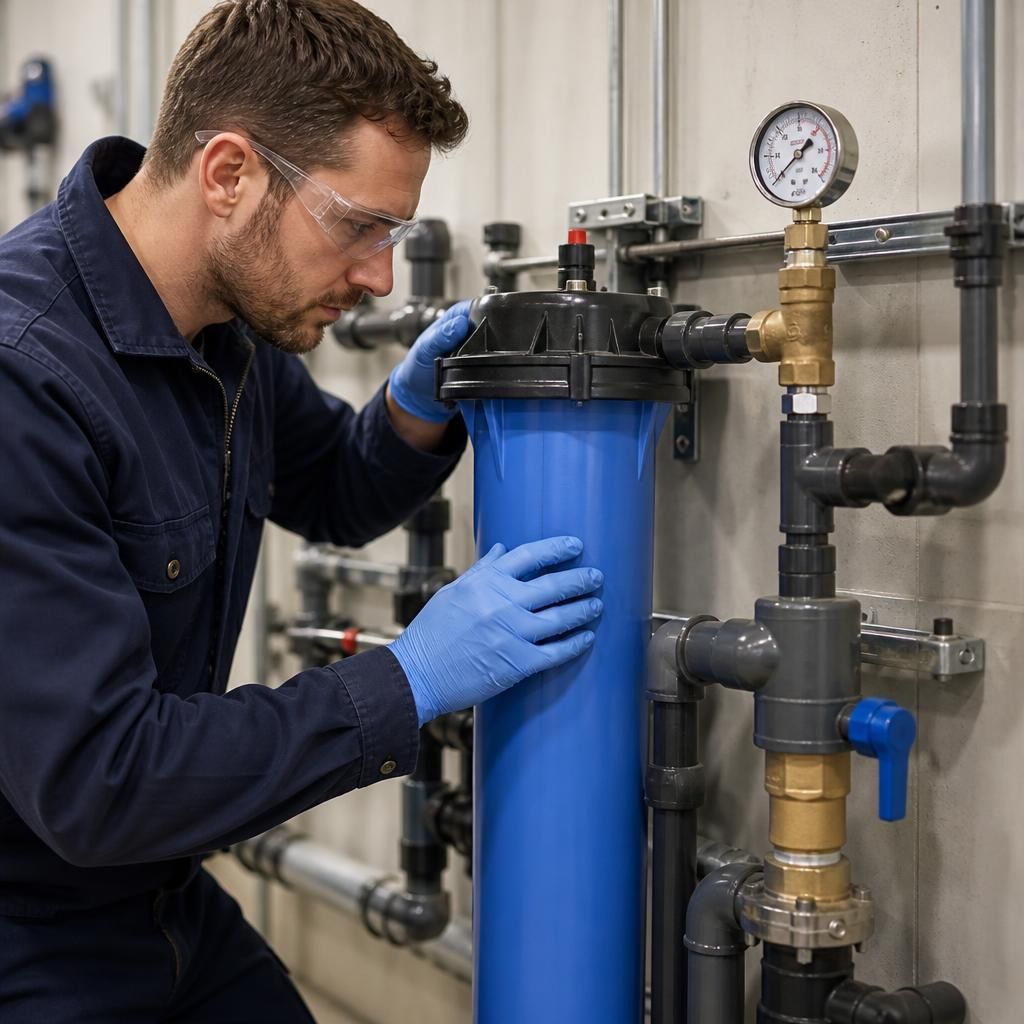
Each maintenance task should include the conditions for taking the chlorine filter or associated equipment out of service and the checks required before it is returned to operation. This should cover safe isolation, depressurisation, drainage and any chemical precautions relevant to the equipment.
- Confirm the correct valves are operated and the intended flow path is understood.
- Check that covers, seals, connections and guards are correctly refitted after work.
- Inspect for leaks or abnormal pressure when the system is brought back into service.
- Verify that controls, alarms and treated-water results are satisfactory before normal operation resumes.
Including these steps in the written schedule helps prevent a completed service task from creating a new operational or water-quality risk.
Discuss Your Chlorine Filter Maintenance Schedule
Discuss your chlorine filter maintenance schedule with Blue Fish Water Management to clarify the inspection, servicing and testing requirements for your equipment. The resulting plan can be aligned with the system design, operating conditions and water safety responsibilities.