
What qualifications should a chlorine disinfection provider have?

A qualified chlorine disinfection provider should be able to demonstrate formal water-hygiene and legionella-control training, task-specific chemical-safety competence, and relevant experience on the type of water system being treated. In the UK, there is not one universal licence that authorises every form of chlorine disinfection. Competence is assessed through the provider’s training, procedures, personnel, technical knowledge and evidence of completed work.
Relevant technical training
Personnel carrying out or supervising disinfection should have training that covers water hygiene, legionella prevention and the principles of chemical disinfection. The training should be appropriate to the work involved, including dosing, circulation, contact time, neutralisation, flushing and the verification of safe water quality before a system is returned to use.
A course certificate alone is not enough. The provider should be able to explain how the training applies to the particular installation, whether it is a domestic hot and cold water system, process-water system, storage tank, pipework installation or another type of commercial asset.
Understanding of UK requirements and technical standards
The provider should work with the requirements that apply to the site and its water systems. This can include the Health and Safety Executive’s approved code of practice and guidance for legionella control, the Control of Substances Hazardous to Health Regulations, the Control of Major Accident Hazards Regulations where relevant, and the Water Supply (Water Fittings) Regulations for applicable installations.
Knowledge of relevant British and European standards is also important. Depending on the work, this may include standards and guidance covering water-system design, commissioning, cleaning, disinfection and sampling. For healthcare premises, the provider may also need to understand the additional requirements set out in NHS technical guidance. A suitably qualified provider should identify which requirements apply rather than relying on a generic treatment method.
Chemical and site-safety competence
Chlorine-based chemicals can cause burns, harmful vapours and dangerous reactions if they are stored, mixed or applied incorrectly. The personnel involved should therefore have demonstrable competence in:
- reading and applying the relevant safety data sheets;
- selecting suitable personal protective equipment;
- storing, transporting and handling treatment chemicals safely;
- preventing incompatible chemicals from coming into contact;
- controlling exposure during dosing, circulation and discharge;
- managing spills, leaks and accidental exposure; and
- protecting building users, contractors and the wider environment during the work.
These arrangements should be reflected in written method statements, COSHH assessments and emergency procedures. Where the work involves confined spaces, work at height, electrical equipment or restricted-access plant rooms, additional task-specific training may be required.
Laboratory and sampling arrangements
Where treatment results require laboratory analysis, the provider should use a suitably competent laboratory. UKAS-accredited testing is relevant because accreditation provides assurance that the laboratory operates against recognised competence requirements for the tests within its scope. The scope should match the parameters being requested; accreditation for one type of test does not automatically cover every water-quality analysis.
The provider should also understand how samples must be taken, preserved, labelled and transported. This includes maintaining sample identification and chain-of-custody information where results may be used for compliance, investigation or handover purposes.
Evidence to request before appointment
A responsible procurement review should consider more than a course certificate. Ask the provider for evidence such as:
- current training records for the people who will plan, supervise and carry out the work;
- examples of method statements and COSHH assessments suitable for chlorine disinfection;
- details of relevant experience with systems comparable to the one being treated;
- the qualifications or competence of anyone taking samples or interpreting results;
- confirmation of the laboratory arrangements and test scope where analysis is outsourced; and
- the provider’s process for reviewing treatment findings and dealing with unexpected results.
Training should also be refreshed when guidance, equipment, chemicals or working methods change. A provider that can explain how it checks ongoing competence is more reliable than one that presents an old certificate without showing how its procedures are controlled.
For complex or high-consequence premises, the client should confirm that the provider’s expertise matches the risks of the site. The relevant question is not simply whether the contractor has attended a chlorine disinfection course, but whether the organisation can safely plan, control and verify the complete treatment process for that specific water system.
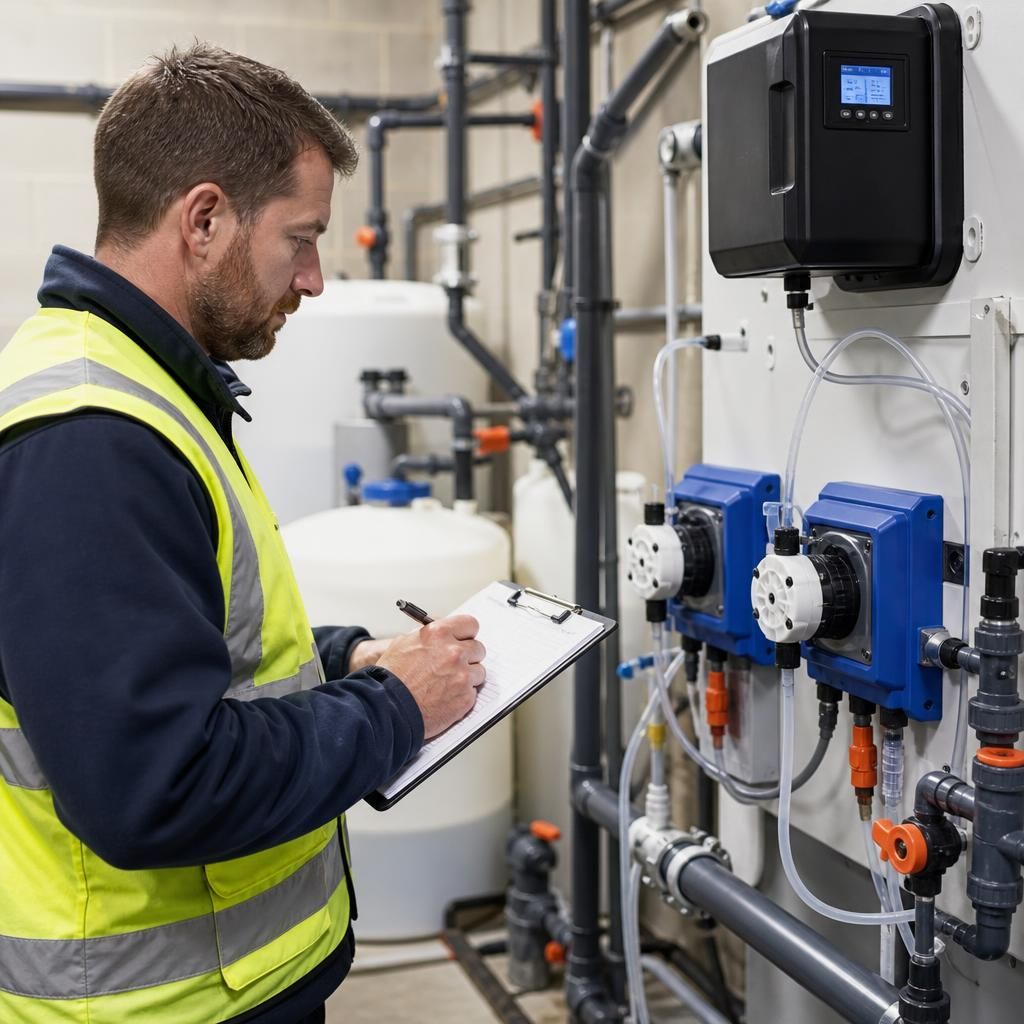
A qualified chlorine disinfection provider should be able to determine whether chlorination is suitable for the specific water system before treatment begins. This requires more than knowing how to dose chemicals: the provider should assess system materials, configuration, operating conditions and the reason for treatment, then identify any restrictions or risks that could affect the proposed method.
Competent advice should also distinguish between routine disinfection, remedial cleaning and situations requiring investigation or engineering work. The provider should explain the treatment limits, the conditions needed for effective contact, and when additional specialist input is necessary. This ability to define an appropriate scope is an important qualification in its own right because applying a standard procedure to an unsuitable system can create damage without resolving the underlying problem.
Discuss Your Chlorine Disinfection Requirements
If you are assessing a chlorine disinfection provider, discuss your water system, treatment objectives and evidence requirements with Blue Fish Water Management Ltd. This helps establish the appropriate scope of work and the competence needed for safe, compliant treatment.