
Which accreditations should a chlorinator and dosing system provider hold?
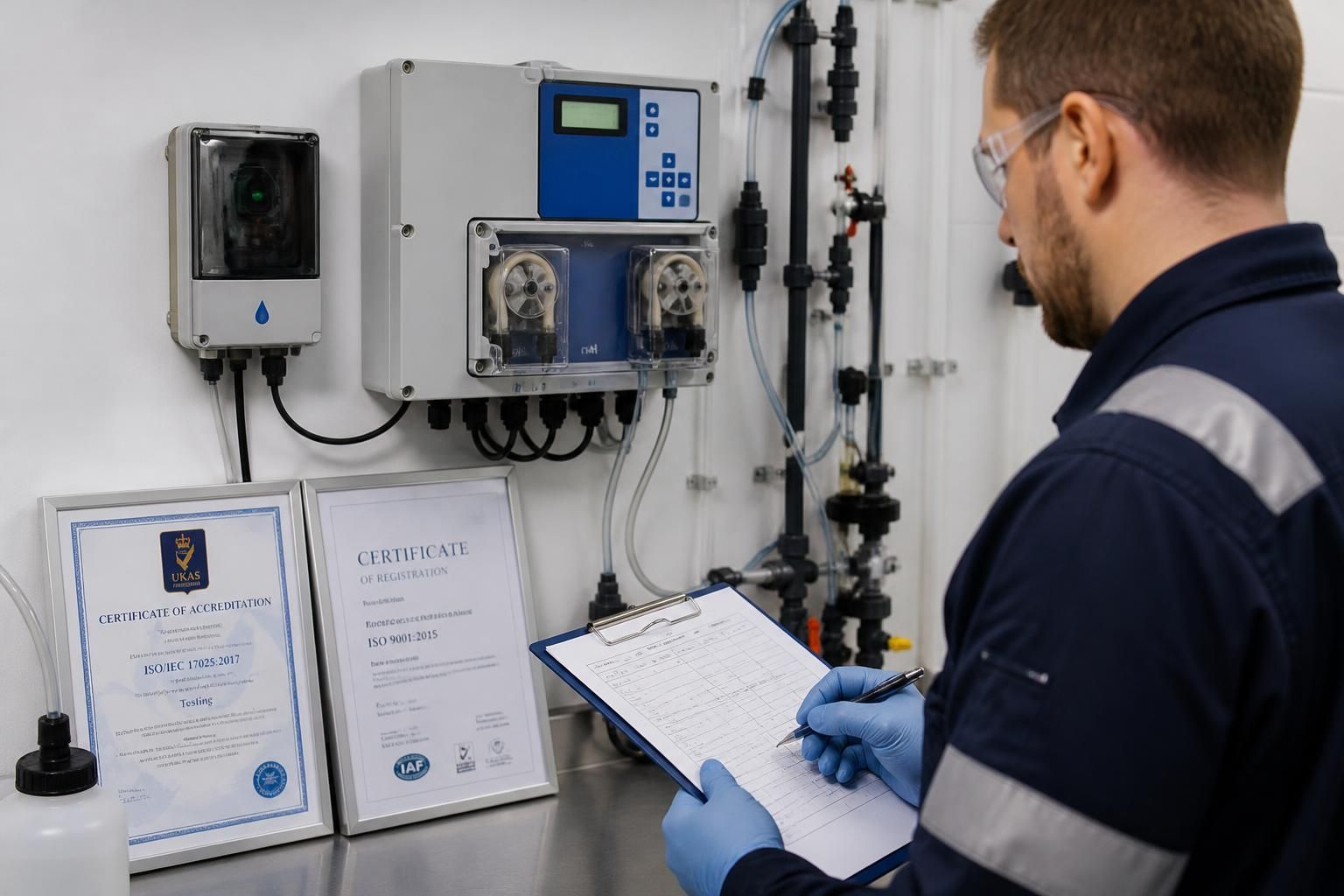
The most relevant accreditation is one that matches the provider’s actual role: testing laboratories should work to a suitable UKAS-accredited scope, while dosing equipment and installation work should be supported by appropriate product approvals, quality controls and documented technical competence. There is no single accreditation that automatically proves a chlorinator and dosing system provider is suitable for every water application.
When assessing a provider, consider the following forms of recognition and approval:
- UKAS-accredited laboratory testing: Where chlorine residuals, microbiological parameters or other water-quality indicators are tested, check that the laboratory is accredited to ISO/IEC 17025 by UKAS for the specific methods and sample types required. The word “UKAS” alone is not sufficient; the accreditation schedule should cover the tests being commissioned.
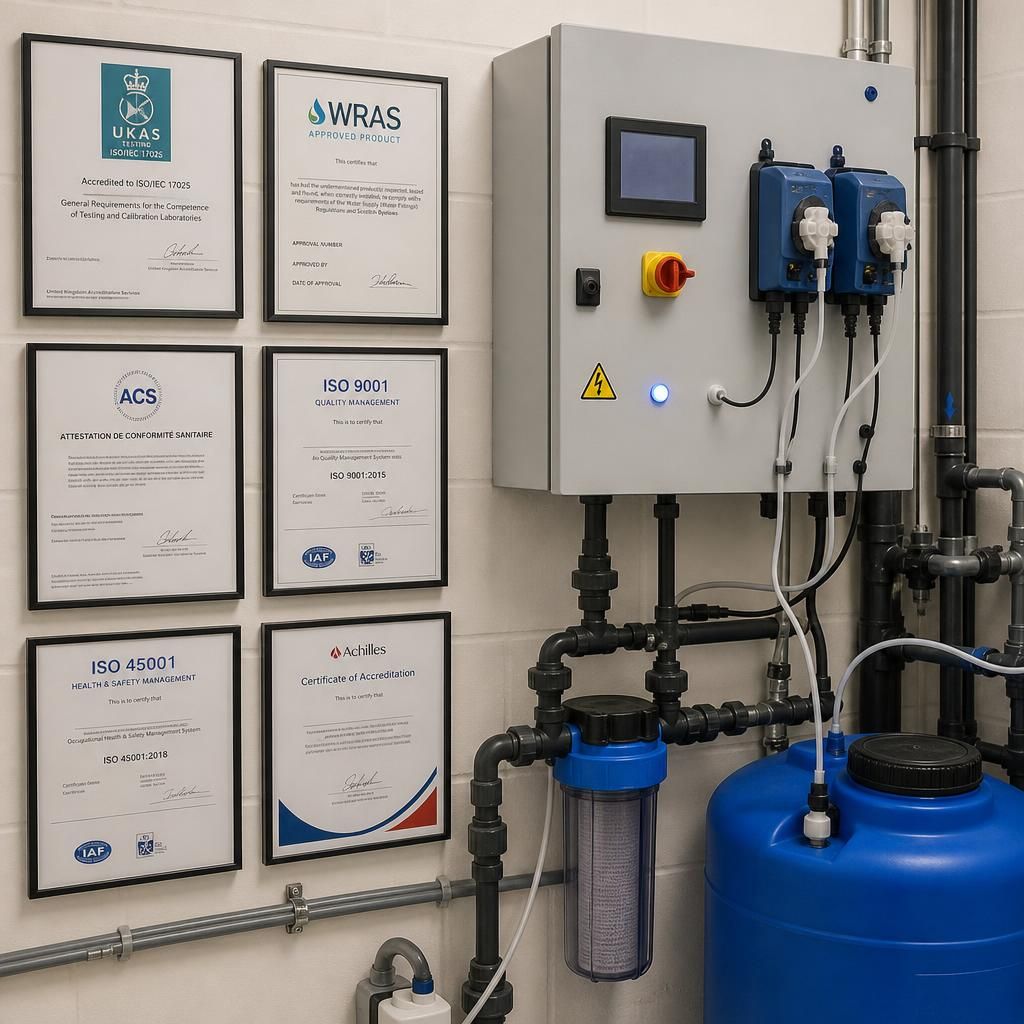
- Product approval for water-contact components: Components connected to drinking-water systems may need approval under the relevant UK water fittings requirements. Depending on the equipment and installation, this can include WRAS approval or another recognised route for demonstrating that materials and fittings are suitable for contact with wholesome water.
- Regulatory acceptance of materials: For products used in public or private drinking-water systems, ask whether wetted materials meet the applicable requirements for substances and products in contact with drinking water, including the relevant requirements set by the Drinking Water Inspectorate where applicable. This is particularly important for tanks, pumps, valves, dosing lines and injection assemblies.
- Quality management certification: ISO 9001 certification can indicate that the organisation operates a defined quality-management system covering document control, purchasing, non-conformity management and corrective action. It does not, by itself, demonstrate that a particular dosing design is technically suitable, so its scope should be read alongside the project evidence.
- Health and safety management certification: ISO 45001 may be relevant where the provider designs, installs or maintains chemical dosing equipment. It can support confidence in the management of work risks, but it is not a substitute for chemical-handling arrangements, site-specific risk assessments or suitable installation controls.
Some projects may also require evidence relating to the monitoring equipment itself. For example, a chlorine analyser or control system may need to meet a recognised performance standard, have traceable calibration arrangements or be suitable for integration with the site’s alarm and building-management systems. These are characteristics of the equipment and its verification process rather than a general accreditation held by the provider.
It is also useful to distinguish genuine third-party accreditation from membership schemes, training certificates and contractor pre-qualification badges. Such schemes may provide useful evidence of insurance, basic compliance or business processes, but they should not be treated as proof that the provider can select, install and validate a dosing system for the intended water use.
Before appointing a provider, request copies of current certificates and examine:
- the legal entity named on each certificate;
- the certificate’s expiry date and certification body;
- the precise scope, including relevant testing methods, installation activities or product categories;
- whether the work will be carried out directly or through an external laboratory or subcontractor;
- the arrangements for calibration, traceability and handling failed or questionable results; and
- the way accreditation and approval requirements will be recorded in the design, commissioning and handover documentation.
A credible provider should be able to explain why each accreditation or approval is relevant to the proposed system, rather than presenting a general list of logos. The assessment should then consider the whole compliance chain: equipment suitability, chemical storage and dosing controls, sampling and testing, alarm management, commissioning records and ongoing review. This gives a more reliable basis for selection than choosing solely by the number of certificates displayed.
Accreditation should be treated as part of the provider’s governance arrangements, not as a one-off procurement check. Ask how certificate status, technical standards and approved procedures are reviewed when equipment, chemicals, site conditions or regulatory requirements change.
A suitable provider should be able to identify who is responsible for monitoring these changes, approving revised procedures and communicating their effect to the project team. This helps ensure that the evidence supporting the chlorinator and dosing system remains relevant from design through operation, rather than relying on a certificate that was valid only when the contract began.
Review your chlorinator provider’s accreditations
Share your proposed chlorination and dosing requirements with Blue Fish Water Management Ltd to discuss the testing, documentation and assurance needed for your water system.