
How should dosing system design accommodate future changes in water demand?
Dosing system design should account for current demand, foreseeable changes in occupancy or usage, and the operating range needed for effective water treatment. Scalable equipment, adjustable dosing control, suitable monitoring points and provision for future modification can help the system remain safe, compliant and efficient as demand changes.

Future-proof dosing system design should be based on documented demand scenarios, hydraulic calculations and planned points of review, rather than on the present flow rate alone. The design must continue to deliver the required chemical dose and water quality when flow, occupancy, process use, storage arrangements or the wider water system change.
A suitable design basis should record the conditions that affect dosing performance, including:
- normal, minimum and peak flow conditions;
- the expected pattern and duration of water use;
- incoming water quality, temperature and chemical demand;
- pipework volumes, storage capacity and estimated turnover;
- the required disinfectant concentration, contact conditions and control limits; and
- planned extensions, changes of use or additional outlets that could alter hydraulic behaviour.
This information allows the designer to assess how the system will behave across different operating cases. A high-flow condition can increase chemical consumption and reduce the time available for treatment, while prolonged low use can increase residence time and the risk of stagnation. These effects should be considered together rather than treating maximum flow as the only important design value.
Design for scenarios, not a single forecast. Demand forecasts are rarely exact, particularly where a building may be extended, occupancy may vary or a process may be changed. The design documentation should therefore identify credible future scenarios and state the assumptions behind each one. For example, an increase in production use may alter both flow and water chemistry, whereas a change in occupancy may produce a different pattern of intermittent demand. Each scenario can then be checked against pump duty, injection performance, mixing, contact conditions and control response.
Where future demand is uncertain, phased implementation can be more appropriate than selecting equipment solely for a distant theoretical maximum. A design may include reserved space, correctly sized connections, isolation arrangements and panel capacity so that later changes can be made without extensive alteration to the existing installation. Any provision for expansion should remain isolated and clearly identified until it is required. Unused branches or dead legs must not create stagnant sections within the treated water system.
Control philosophy is also important. Dosing should respond to the relevant process variable, such as measured flow or disinfectant residual, while remaining subject to suitable upper and lower limits. The control system should define what happens during low flow, loss of signal, analyser failure, chemical depletion, loss of pressure or an unexpected rise in demand. Interlocks and alarms should prevent uncontrolled dosing and identify conditions that require investigation. Where demand changes materially, the control sequence may need to be reviewed rather than simply increasing the pump setting.
The design should distinguish between chemical capacity and treatment capacity. A pump may be capable of delivering a greater volume of chemical, but that alone does not demonstrate that the water system can mix it effectively, achieve the required contact conditions or maintain an appropriate residual at representative points. Changes to storage or pipework can alter residence time and dilution, so hydraulic performance and water-quality results should be reassessed after significant modifications.
Practical provisions can make future alterations safer and easier to verify. These may include:
- accessible isolation points and injection arrangements;
- sampling locations that remain representative after extensions or changes in flow;
- adequate bunding, chemical storage and safe access for inspection and maintenance;
- clearly labelled spare connections and documented cable or communication routes;
- separation of treated and untreated flows where applicable; and
- records showing design assumptions, set points, alarm limits and commissioning results.
Future changes should be managed through a formal change-control process. Before an alteration is made, the responsible person should confirm how it affects the water safety risk assessment, hydraulic balance, chemical demand, monitoring arrangements and maintenance requirements. After the change, the system should be commissioned or revalidated as appropriate, with checks on flow, dose, residual, alarms and sampling results. Updated drawings, operating instructions and maintenance records are part of the design response, not an administrative afterthought.
In practice, a dosing system accommodates future demand most effectively when its design assumptions are transparent and its limits are understood. A documented review should be triggered by changes such as building extensions, altered occupancy, new process equipment, additional storage, changes in source water or persistent changes in monitoring results. This provides a controlled basis for modifying the system while maintaining effective legionella control and demonstrating ongoing water safety compliance.
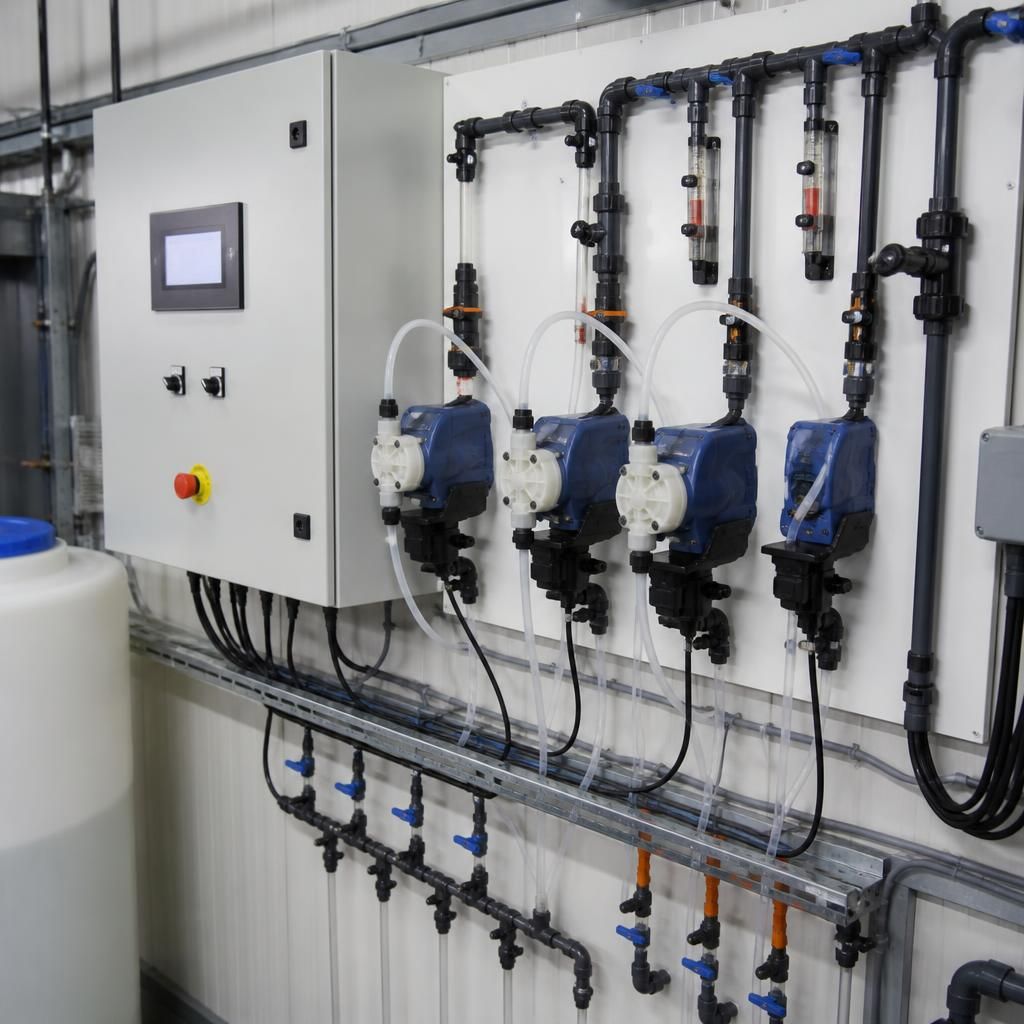
Future-proof dosing system design should avoid relying on oversized equipment as the only response to possible demand growth. A pump selected for a distant maximum flow may operate poorly at present-day demand, where its minimum controllable output, start-stop behaviour and measurement accuracy become more important.
The design should therefore define the usable operating range, including the lowest stable dose and the conditions that require staged or supplementary capacity. This helps maintain controlled dosing during periods of low use while retaining a practical route to increased demand. The selected arrangement should also allow key components, sensors and control interfaces to be replaced or upgraded without making the whole system unsuitable for the revised duty.
Plan for future changes in water demand
Discuss planned changes in water demand with Blue Fish Water Management Ltd to establish whether your existing dosing system design remains suitable and what information is needed for a controlled review.