
Who is responsible for tank chlorination in commercial premises?
Responsibility for tank chlorination in commercial premises usually rests with the person or organisation controlling the water system, such as the employer, landlord, facilities manager or dutyholder. A competent water hygiene contractor may carry out the chlorination, but the dutyholder remains responsible for arranging suitable work, retaining records and verifying that risks have been controlled.

Responsibility for tank chlorination is determined by who controls the commercial water system and can take reasonable steps to manage its risks. Ownership alone is not always decisive. Depending on the premises and contractual arrangements, responsibility may sit with an employer, landlord, managing agent, facilities manager, occupier or another appointed dutyholder.
The dutyholder’s core responsibilities include ensuring that the water system is assessed, maintained and operated in a way that controls the risk of Legionella and other contamination. Where tank chlorination is identified as necessary, the dutyholder should arrange suitable work, provide the contractor with accurate system information, ensure affected users are protected and retain evidence of the work and its results.
Chlorination should not be treated as an isolated chemical treatment. It is normally one part of a wider water hygiene control programme. The person responsible should understand why the work is needed, what parts of the system are included, how the system will be isolated, how outlets will be managed and what checks are required before the water supply is returned to normal use.
Employers and occupiers usually have responsibility for systems serving premises that they control, particularly where they employ staff, operate equipment or manage activities that depend on the water supply. This may include offices, factories, care settings, educational premises, leisure facilities and other commercial buildings. An occupier should not assume that a landlord remains responsible for all water hygiene matters if the occupier controls the internal distribution system, storage tanks or maintenance arrangements.
Landlords and property owners may retain responsibility for shared systems, central plant, storage tanks and services that they maintain for several tenants. The lease or service agreement may allocate particular tasks to the landlord, tenant or managing agent, but written arrangements should be clear about which party controls each part of the system. Where responsibilities overlap, the parties should co-operate rather than assume that another organisation has arranged the work.
Facilities managers and managing agents often coordinate inspections, maintenance and specialist contractors on behalf of the organisation in control of the premises. They may arrange tank chlorination and manage the associated records, but their appointment does not automatically remove the client’s duty to ensure that the arrangements are appropriate. The scope of their authority should cover access, isolation, remedial work and follow-up testing where these are necessary.
The water hygiene contractor is responsible for carrying out the agreed chlorination safely and competently. This can include reviewing available system information, preparing a method statement, selecting suitable chemicals and contact conditions, protecting users, flushing the system and taking samples for analysis. The contractor should report limitations, unexpected conditions or incomplete access rather than treating an unsuitable system as fully completed.
Appointing a contractor does not transfer every legal or management responsibility to that contractor. The dutyholder remains responsible for selecting a suitably competent provider, giving accurate information, checking that the work matches the identified risk and responding to the findings. A contractor may identify defects, but the person controlling the premises generally needs to authorise and arrange any wider repair or improvement work.
Competence is important on both sides. The organisation commissioning the work should be able to understand the system, specify the required outcome and review the report. The contractor should have the knowledge, experience, equipment and procedures needed for the type of tank and water system involved. Where sampling is required, the client should establish what testing will be carried out, which laboratory will undertake it and how the results will be interpreted.
Before work begins, responsibility should be documented through a clear scope of work. This should identify the tanks and connected pipework included, access arrangements, isolation points, safety controls, chemical handling requirements, flushing arrangements, sampling points and the process for dealing with unsatisfactory results. It should also state who will decide whether the system can be brought back into service.
After chlorination, the responsible organisation should retain the treatment report, records of the system covered, relevant measurements, laboratory results, certificates or completion documents, details of any restrictions and recommendations for further action. These records support the written control scheme and help demonstrate that the work was considered as part of ongoing water system management, rather than arranged without follow-up.
Where ownership, occupation and maintenance duties are divided, a responsibility matrix can prevent gaps. It should cover the risk assessment, routine monitoring, tank inspections, chlorination, repair of defects, sampling, record keeping and escalation of failed results. Blue Fish Water Management can support organisations by assessing the relevant water system, arranging appropriate water hygiene work and providing testing or compliance advice suited to the premises.
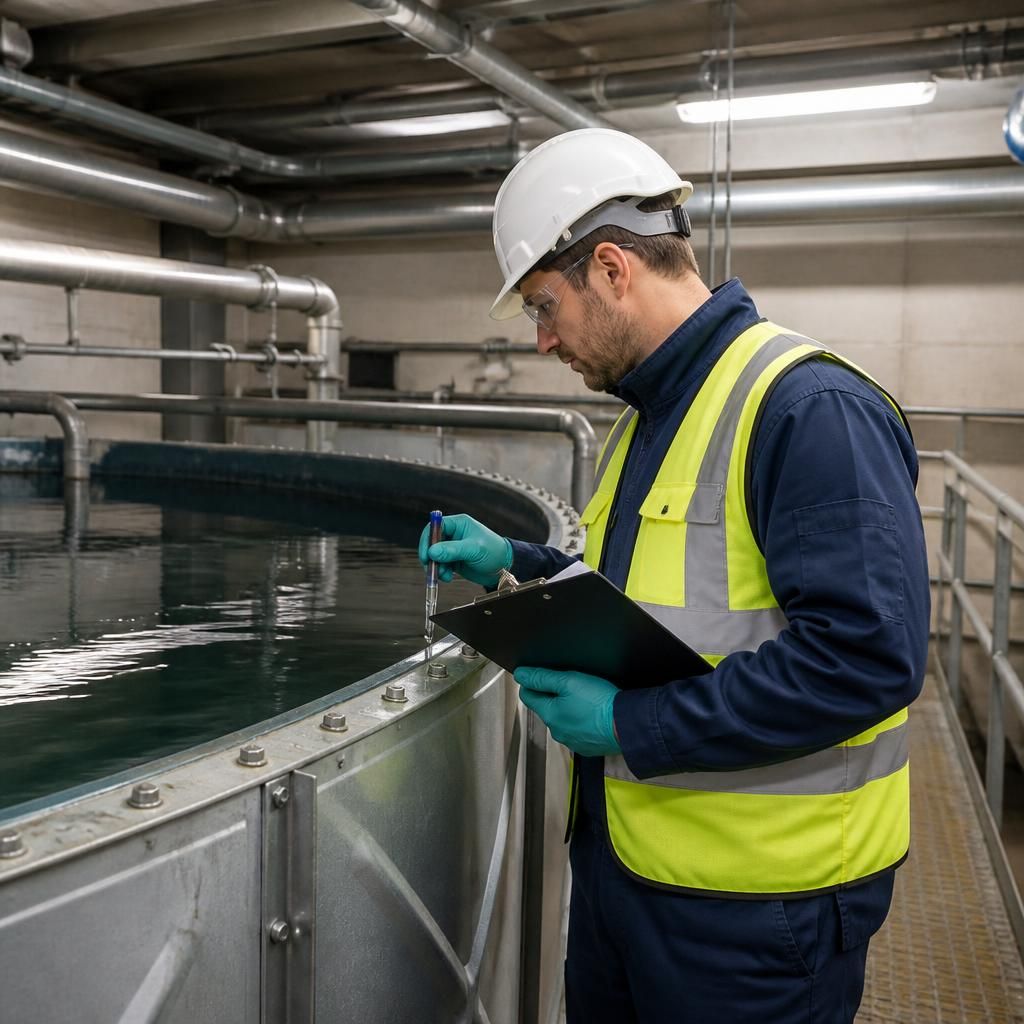
In shared commercial premises, responsibility may change at the point where one organisation’s control ends and another’s begins. For example, a landlord may control the main storage tank and arrange its chlorination, while a tenant controls internal outlets and the activities taking place in the building. The relevant agreement should identify these boundaries clearly rather than assigning responsibility only by job title.
A useful test is to ask which organisation can authorise access, isolate the affected section, approve remedial work and restrict use if the treatment outcome is unsatisfactory. If those decisions sit with different parties, each decision-maker should be identified and the handover between them documented. This helps prevent a tank being treated without the connected system, or a failed result being reported without anyone authorised to act on it.
Review Your Commercial Tank Chlorination Responsibilities
Review your commercial tank chlorination arrangements to confirm that responsibilities, access and follow-up actions are clearly assigned. Blue Fish Water Management can provide practical advice and water hygiene support tailored to your premises.