
What accreditation should a chlorination for water testing provider hold?

Accreditation should be judged against the particular chlorination and water-testing activities being commissioned, rather than the provider’s general quality credentials. A credible provider should be able to distinguish laboratory accreditation, inspection accreditation, management-system certification and individual staff competence, because each demonstrates something different.
Check what the accreditation actually applies to. A certificate may belong to a laboratory used by the provider rather than to the contractor carrying out the site work. That is not necessarily a problem, provided the relationship is transparent and the provider remains responsible for arranging suitable sampling, documentation and reporting. Ask whether testing is performed in-house or subcontracted, and identify the laboratory named on the test report.
The accreditation schedule is more informative than a certificate displayed on its own. It should show the activities for which the organisation has been assessed, together with the relevant methods and technical limitations. A provider should not present accreditation for one type of analysis as evidence that every water-testing activity or chlorination service is accredited.
ISO 17020 may be relevant in a different type of assignment. This standard concerns the competence and impartiality of inspection bodies. It can be relevant where an organisation is carrying out formal inspection or conformity-assessment work, but it is not a universal requirement for every contractor that undertakes chlorination and submits water samples for analysis. Its relevance depends on the scope of the service and the conclusions the provider is being asked to issue.
ISO 9001 should not be confused with technical accreditation. It indicates that an organisation operates a documented quality-management system. It may support consistent administration, document control and corrective-action processes, but it does not by itself prove that the provider can select a suitable chlorination method, take representative samples or interpret water results correctly.
Nor do contractor-vetting schemes, trade memberships or health and safety certificates replace technical accreditation. They may provide useful information about insurance, business processes or site controls, but they do not validate the scientific reliability of a water test. Similarly, guidance such as the Health and Safety Executive’s legionella guidance helps define sound control practice; it is not an accreditation awarded to a chlorination provider.
Before appointing a provider, request evidence covering:
- the current certificate and its accreditation schedule;
- the identity and status of any laboratory used for analysis;
- the provider’s procedure for recording the work, samples, test results and any deviations;
- how sample containers, measuring equipment and test instruments are controlled and maintained;
- how failed, abnormal or inconclusive results are investigated and reported;
- the arrangements for subcontractors, including who reviews their reports and retains responsibility for the final information.
Accreditation is therefore one part of due diligence, not a substitute for examining the proposed method and service controls. The provider should explain which organisation performs each stage, what evidence will be supplied after the work and how the results will support the client’s wider water-safety records. This approach helps distinguish a technically controlled service from one that relies mainly on a general quality badge.
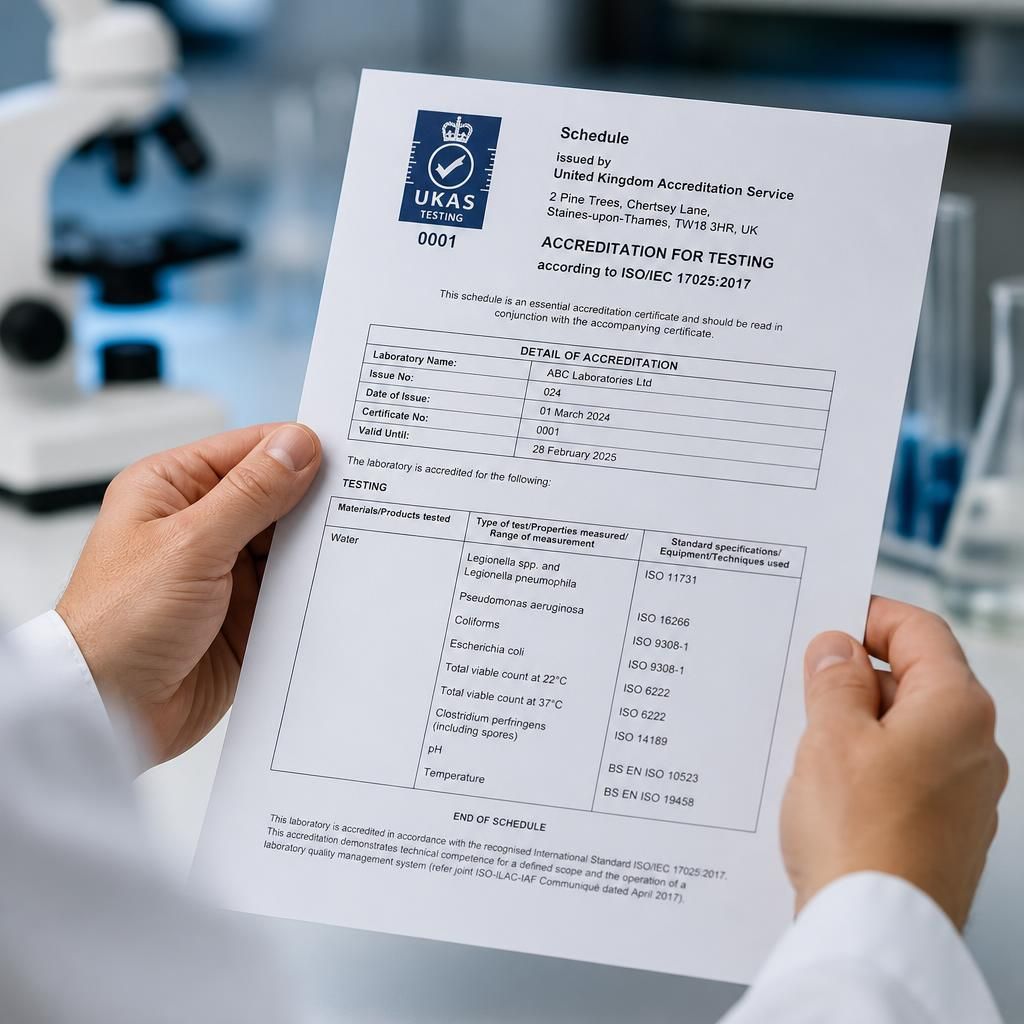
A UKAS-accredited test report should make clear which results were produced under the laboratory’s ISO/IEC 17025 scope and which information is interpretation, commentary or advice. Accreditation supports confidence in the laboratory’s competence to perform the specified analysis; it does not independently approve every conclusion added to the report or certify the chlorination work itself.
When reviewing a report, check the accreditation mark or statement, the laboratory’s name, the methods used and any exclusions or limitations. Results outside the accredited scope should be identified clearly rather than presented as though they have the same status. This distinction helps the client’s responsible person decide which findings can be relied on as formal test evidence and which require further technical review.
Review your water chlorination provider’s accreditation
Need help assessing a provider’s accreditation and supporting documentation for chlorination testing? Contact Blue Fish Water Management Ltd to discuss your water-safety requirements and the evidence needed for informed procurement.