
How are Legionnaires risk assessment findings prioritised?
Legionnaires’ risk assessment findings are prioritised according to the potential for Legionella exposure, the vulnerability of people using the water system, and the effectiveness of existing controls. Immediate hazards require prompt action, while lower-risk findings are assigned planned corrective measures, monitoring or review based on their significance.

Legionnaires’ risk assessment findings are prioritised by considering the seriousness of the hazard, the likelihood that people could be exposed, the condition and use of the water system, and the reliability of the controls already in place. The assessment should translate those findings into a documented order of action, with clear responsibilities, timescales and arrangements for checking that corrective work has been completed effectively.
Prioritisation is not based on a single laboratory result or an isolated defect. An assessor considers how different factors combine. For example, a poorly controlled hot-water system serving showers may warrant more urgent attention than a similar temperature deviation in a rarely used outlet, particularly where the building is occupied by people who may be more susceptible to serious illness.
Findings requiring immediate attention usually involve a credible and current risk of exposure, a significant breakdown in control, or circumstances in which people may be exposed to contaminated aerosols. Examples can include:
- Evidence that essential temperature control has been lost across a system used for bathing or showering.
- Uncontrolled aerosol-producing outlets, such as showers or spa facilities, where the system condition is uncertain or known to be poor.
- Significant stagnation, contamination or defects affecting storage tanks, distribution pipework or hot-water systems.
- Failure of monitoring, disinfection or other control measures where no reliable alternative protection is operating.
- Findings that coincide with suspected or confirmed cases of Legionnaires’ disease and require coordinated investigation.
Immediate actions may include restricting use of particular outlets, isolating part of a system, arranging remedial cleaning or disinfection, correcting temperature or circulation problems, and obtaining further technical advice. The appropriate response depends on the system and the evidence available. A positive sample does not, by itself, determine the whole response; its significance must be considered alongside sampling quality, system operation, exposure routes and other assessment information.
High-priority findings are serious weaknesses that may not require an immediate shutdown but should be corrected promptly. These can include repeated temperature failures, ineffective return circulation, substantial dead legs, inadequate cleaning of storage tanks, missing or unreliable monitoring records, or a control scheme that is not being followed. A finding may also move into this category where several moderate defects affect the same part of the system and together create a more substantial risk.
Planned corrective actions address important issues that are not creating the same level of immediate concern but could undermine long-term control. Examples include improving schematic diagrams, updating written procedures, removing redundant pipework, improving access for inspection, repairing insulation, reviewing sampling points or strengthening staff training. The action plan should still include a target date and named person responsible. “Monitor” should not be used as a substitute for a defined control or a decision about what will happen if the condition deteriorates.
Lower-priority findings generally relate to minor documentation gaps, housekeeping issues or improvements that support good management without indicating an immediate exposure risk. They should be recorded and closed through routine management arrangements rather than overlooked. Their priority may need to be raised if the system changes, occupancy changes, monitoring identifies deterioration, or a related control failure occurs.
Several assessment factors help determine where a finding sits in the action plan:
- Exposure route: Showering, spray taps, spa pools, humidifiers and other aerosol-generating uses can increase the opportunity for inhalation.
- System condition: Corrosion, scale, biofilm, sludge, poor flow, low-use outlets and redundant sections can make control more difficult.
- Temperature performance: The assessor reviews whether hot and cold water systems are being stored, distributed and monitored in a way that supports Legionella control.
- Occupancy and vulnerability: Hospitals, care settings, supported accommodation and workplaces or facilities used by people with increased susceptibility may require more cautious prioritisation.
- Control reliability: The quality of written schemes, routine checks, maintenance, sampling, records and staff competence affects confidence in the existing arrangements.
- Extent of the issue: A fault affecting one isolated outlet is assessed differently from a failure affecting a whole building or several linked systems.
The final priority should be proportionate and evidence-based. A competent assessor records why an action has been ranked, what risk it addresses, who will complete it, when it is due and how completion will be verified. This prevents a long list of defects from obscuring the findings that need attention first.
Once corrective work is completed, the responsible person should not assume that closing the work order proves the risk has been controlled. Relevant checks, measurements, cleaning records, commissioning information or follow-up sampling may be needed, depending on the nature of the finding. If the work changes the design, operation or use of the water system, the risk assessment and written control arrangements should be reviewed so that the priorities remain accurate.
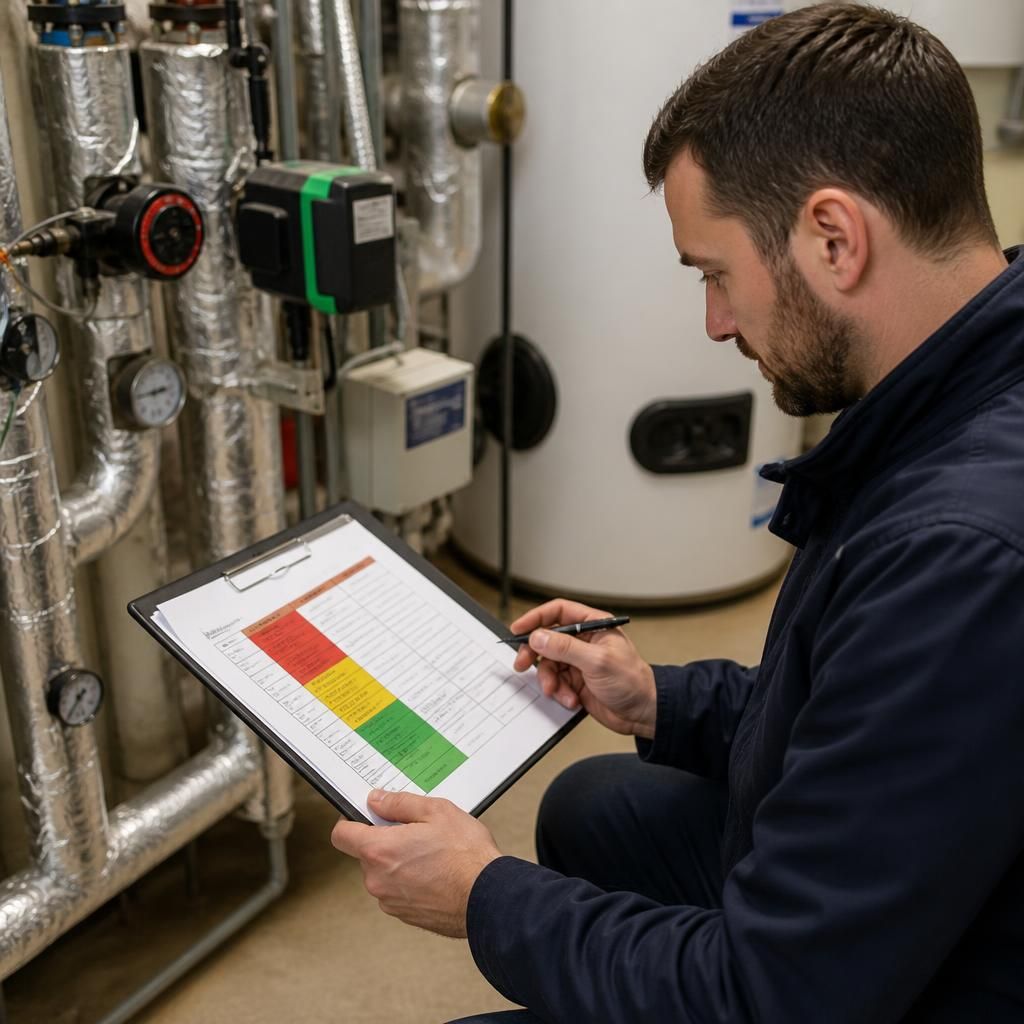
A prioritised action plan should show the sequence in which work needs to be completed, not just label findings as high, medium or low priority. Some actions enable others: confirming the system layout may be necessary before investigating circulation, while restoring access to a tank or plant room may be needed before inspection and cleaning can be properly carried out.
The responsible person should therefore check whether one finding depends on another and record those links in the plan. This prevents isolated tasks from being closed while the underlying control remains incomplete. Where the order of work changes the level of risk, the reason for that sequence should be documented and reviewed when new information becomes available.
Discuss your Legionnaires’ risk assessment findings
Discuss your Legionnaires’ risk assessment findings with Blue Fish Water Management Ltd to clarify their technical implications and consider appropriate next steps. Contact the team to arrange a professional review of your report and control arrangements.