
Does every commercial water system require a Legionnaires disease risk assessment?
Most commercial premises with water systems should have a Legionnaires’ disease risk assessment, but the legal requirement is determined by the foreseeable risk rather than simply by the system being commercial. Where a business controls premises or water systems that could expose people to Legionella bacteria, it must assess the risk and take suitable control measures in line with UK health and safety guidance.

No. A commercial water system does not automatically require the same level of Legionnaires’ disease assessment simply because it is located in a commercial premises. The need for action depends on whether there is a reasonably foreseeable risk of exposure to Legionella and how that risk is controlled. Where the risk is negligible and can be adequately justified, the assessment should still record why no further controls are necessary.
The assessment should consider every relevant water system under the organisation’s control, rather than focusing only on the main hot and cold water services. Depending on the premises, this may include:
- hot and cold water systems supplying taps, showers and other outlets;
- stored hot water cylinders, tanks and distribution pipework;
- cooling towers, evaporative condensers and other systems that can produce contaminated aerosols;
- spa pools, whirlpool baths, humidifiers and air-conditioning equipment using water;
- emergency showers, safety equipment and little-used outlets; and
- temporary, redundant or infrequently occupied areas of a building.
The main issue is not the system’s commercial classification but the combination of conditions that could allow Legionella to grow and spread. A competent assessment will typically examine water temperatures, storage arrangements, areas of stagnation, dead legs, infrequently used outlets, scale, corrosion, water quality, aerosol generation and the condition of tanks, cylinders and pipework. It should also take account of the people who could be exposed, including employees, visitors, contractors, residents, patients, customers and others who may be particularly vulnerable to serious infection.
A straightforward system with good temperature control, regular use and limited opportunity for aerosol exposure may present a relatively low risk. That does not mean it can be excluded without consideration. Conversely, a building with showers, stored water, complex distribution networks, cooling equipment or areas that are often unoccupied may require a more detailed assessment and more structured control measures.
Responsibility normally rests with the person or organisation that controls the premises or the relevant water systems. In a multi-occupancy building, duties may be divided between a landlord, managing agent, facilities team, employer, tenant or specialist contractor. The arrangements should identify who controls each part of the system, who carries out monitoring and maintenance, and how information is shared. A contract does not automatically transfer the legal responsibilities of the person in control; roles and boundaries need to be clear.
The assessment should be suitable and sufficient for the premises. It should identify the systems covered, the hazards found, the people at risk, the existing precautions, any additional measures required and the person responsible for implementing them. Where a significant risk is identified, the findings should support a written control scheme setting out procedures such as temperature checks, flushing, cleaning, disinfection, maintenance, remedial work and record keeping. Sampling or laboratory testing may be appropriate in particular circumstances, but testing is not a substitute for managing the underlying system.
Some commercial premises may have simple water arrangements that do not present a significant foreseeable risk. In those cases, a proportionate documented assessment can explain the conclusion and the controls that remain necessary. This is different from assuming that a system is safe because it is small, modern or rarely used. Low occupancy and limited use can increase stagnation, while a newly installed system can still contain design or commissioning issues.
The assessment should be reviewed when there is a reason to believe that it is no longer valid. Relevant triggers include changes to the building or its occupancy, alterations to water services, changes in use, prolonged shutdown, findings from monitoring, an outbreak or suspected case, significant maintenance defects, or evidence that control measures are not being followed. Even where no major change occurs, the organisation should have a defined review process rather than treating the original document as permanent.
For complex premises or systems, the work should be completed by someone with suitable knowledge, training and experience in water systems and Legionella control. Blue Fish Water Management Ltd provides Legionella risk assessments and related water hygiene support for commercial and industrial organisations, helping dutyholders understand the level of risk and the controls their particular systems require.
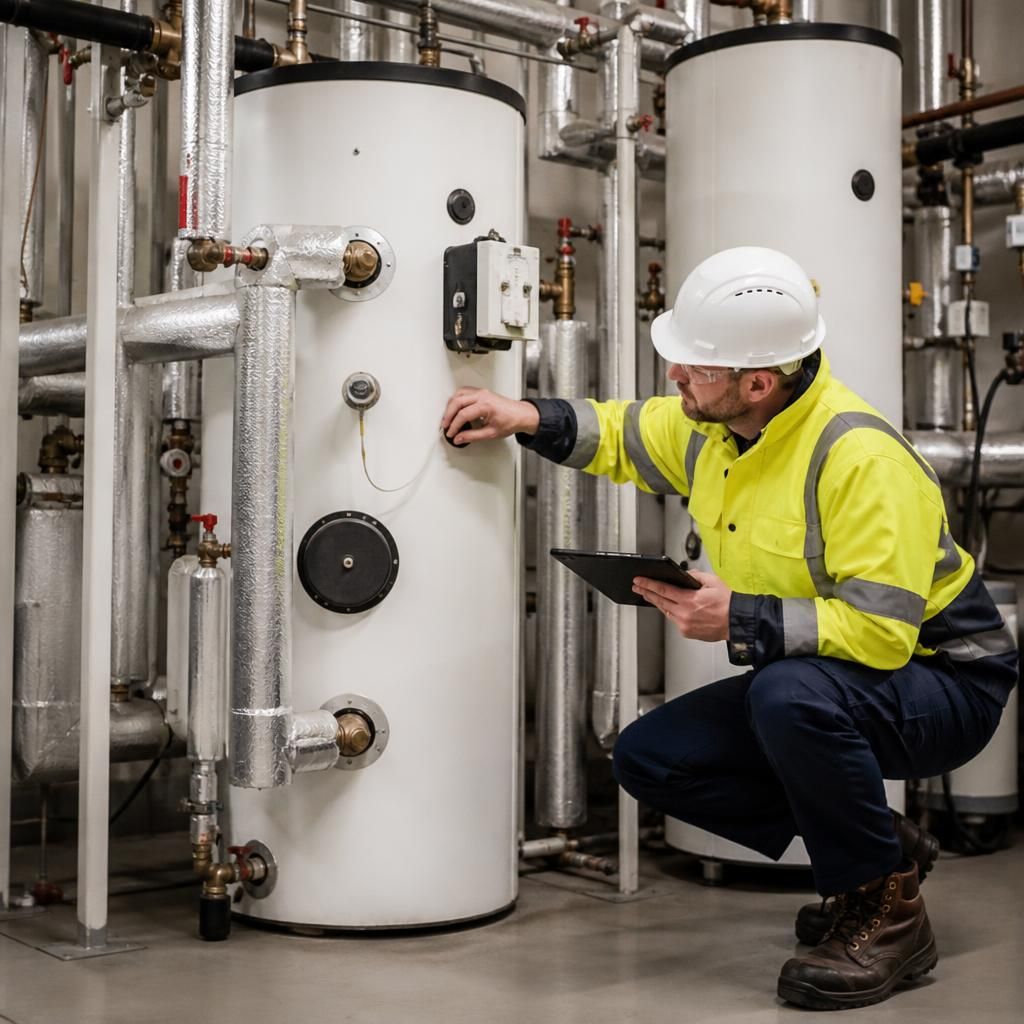
A commercial site does not usually need a separate Legionnaires’ disease risk assessment for every individual outlet or item of equipment. A single assessment may cover several connected systems, provided its scope is clear and it considers how the storage tanks, cylinders, pipework, outlets and associated equipment interact.
The important requirement is that no relevant source of risk is left outside the assessment. Separate documentation may be appropriate where systems are physically independent, operate under different management arrangements or have substantially different hazards, such as a cooling system alongside domestic hot and cold water services. The assessment should make these boundaries clear so that responsibility for each system can be demonstrated.
Discuss Your Commercial Legionnaires’ Disease Risk Assessment
If you are unsure whether your commercial water systems have been assessed on a suitable and sufficient basis, discuss your requirements with Blue Fish Water Management Ltd to clarify the appropriate scope and next steps.