
When should a legionella inspection survey be repeated?

The repeat interval for a legionella inspection survey should be set through a documented, risk-based review rather than treated as a fixed calendar exercise. The responsible person should assess whether the existing survey still accurately reflects the water systems, building use, occupants and control arrangements, then commission a further inspection where the information is no longer reliable or sufficiently current.
There is no single repeat frequency that is suitable for every premises. A low-complexity system with stable occupancy and well-controlled temperatures may require a different review approach from a large healthcare, residential, educational, leisure or industrial site. The decision should be justified by the findings of the previous survey and recorded within the water safety management arrangements.
Factors that influence the review interval include:
- the complexity and size of the hot and cold water systems;
- the presence of storage tanks, calorifiers, showers, spray-producing outlets or other aerosol-generating equipment;
- water turnover, periods of low use and areas containing rarely used outlets;
- the susceptibility of people who may be exposed, including older people or those with weakened immune systems;
- the reliability of temperature control, disinfection and other operational measures;
- the quality and consistency of monitoring records;
- previous survey findings, remedial work and any recurring control issues; and
- the competence, continuity and effectiveness of the people managing the system.
A repeat inspection should be considered when the previous report is no longer an accurate description of the site. This can happen even where the building itself appears unchanged. Alterations to pipework, plant, outlets, valves, storage arrangements or control devices can affect water movement and temperatures. Changes in how rooms are occupied or managed may also alter the likelihood of exposure.
The extent of the repeat survey should match the reason for carrying it out. A competent assessor may be able to confirm that a focused review is appropriate where only a defined part of the system has changed. A full inspection is more appropriate where the system has been substantially modified, records are incomplete, previous recommendations have not been verified, or the original survey did not provide enough information to support effective control.
A repeat survey commonly involves checking:
- schematic drawings and asset registers against the installation on site;
- the condition, accessibility and identification of tanks, calorifiers, pipework and outlets;
- stored and circulating water temperatures at relevant points;
- dead legs, redundant branches, low-use outlets and areas of poor flow;
- showerheads, hoses, strainers and other components that may require cleaning or maintenance;
- the allocation of responsibilities between the duty holder, responsible person, contractors and site staff; and
- monitoring, cleaning, disinfection, sampling and remedial-action records.
An inspection survey is not a replacement for routine control measures. Between formal surveys, the responsible person should continue the monitoring and maintenance programme identified by the risk assessment. Temperature checks, flushing of infrequently used outlets, cleaning and disinfection, corrective actions and other controls should be completed at the specified intervals, with exceptions and failures investigated rather than simply carried forward to the next survey.
After a repeat inspection, the findings should be converted into a prioritised action plan. Each action should identify what must be done, who is responsible, the target completion date and how completion will be verified. Where remedial work changes the system, a follow-up check may be needed to confirm that the work has removed the original risk and that the water management arrangements have been updated.
The review date should be recorded in the risk assessment or water safety plan, alongside the reasons for selecting it. Useful records include the inspection report, photographs or drawings where relevant, temperature and sampling results, maintenance evidence, completed remedial actions and any decision to use a focused rather than full survey. These records demonstrate how the repeat interval was determined and help the next assessor understand the system’s history.
Where uncertainty exists about the condition of a system, the adequacy of existing records or the significance of a change, the safer approach is to obtain advice from a competent legionella professional. Blue Fish Water Management can help businesses assess whether an existing survey remains suitable, identify where a repeat inspection is needed and translate the findings into practical water hygiene actions.
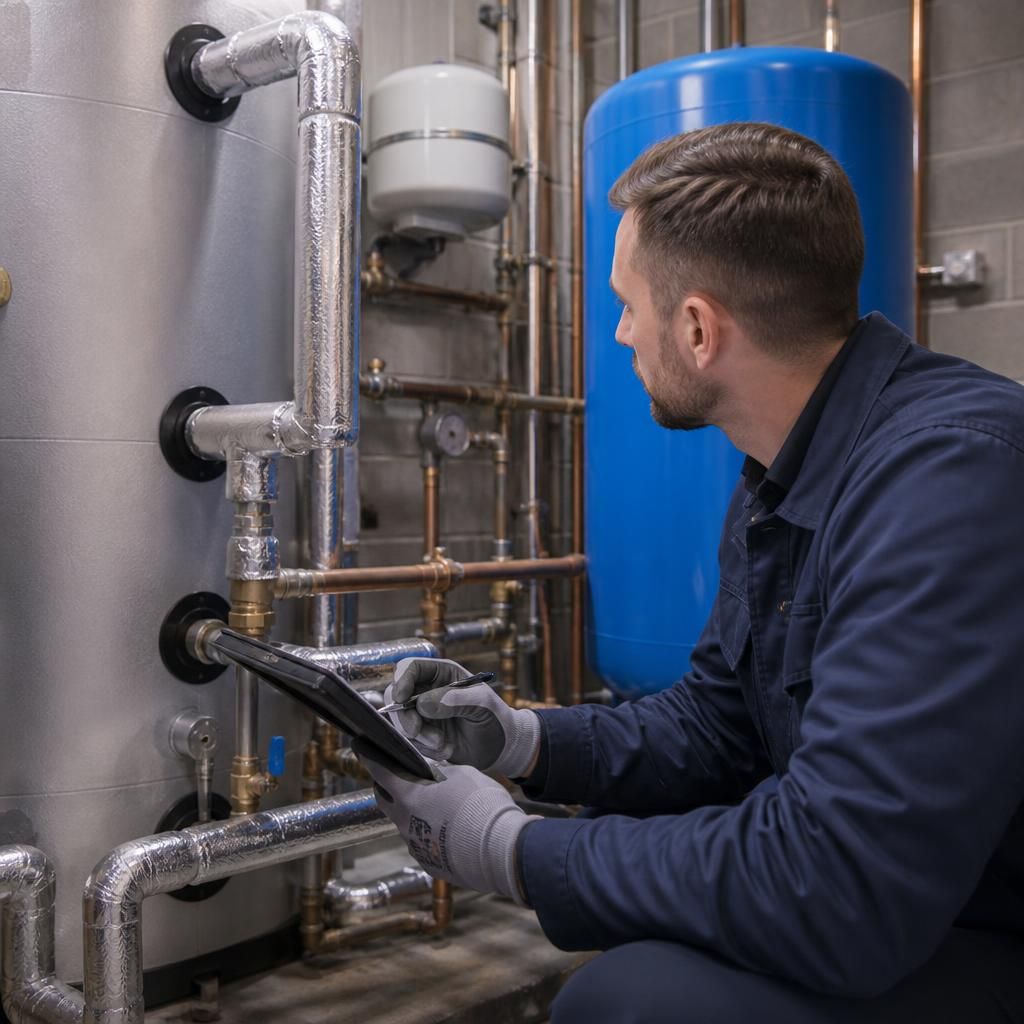
Repeating a legionella inspection survey is a risk-based review of whether the existing assessment remains suitable, not simply the automatic expiry of a report. In the UK, a two-year review point is commonly used as a practical benchmark, but the appropriate interval depends on the premises, water systems and evidence supporting ongoing control.
The review should also consider whether a shorter interval is justified. For example, recurring temperature failures, unresolved actions, unreliable records or changes in the people exposed may indicate that waiting for the next planned date would be inappropriate. Conversely, where the system, its use and its management arrangements remain stable, the responsible person should still document why the existing survey remains sufficiently current.
Recording this reasoning is important. It shows how the repeat date was selected and helps distinguish a genuine risk-based decision from an inspection being postponed without justification.
Discuss your legionella survey review
If you are unsure whether your current legionella inspection survey remains suitable, discuss the review with Blue Fish Water Management. Our team can help you determine the appropriate next step for your water management arrangements.