
Who should carry out a legionella risk assessment?

The legal responsibility for legionella control remains with the duty holder, even when an assessment is commissioned from an external consultant. The appointed assessor must be able to demonstrate relevant knowledge, practical experience and an understanding of the water systems, building use and people who may be exposed.
Who may carry out the assessment?
- A competent employee: An in-house employee may complete the assessment where they have suitable training, experience and sufficient authority to inspect the system, speak to relevant staff and recommend corrective action.
- An independent specialist: An external water hygiene or legionella consultant may be appropriate where the site is complex, internal knowledge is limited, an impartial review is needed or the assessment requires specialist technical judgement.
- A suitably qualified water professional: A person with practical experience of hot and cold water services, water storage, distribution and control measures may be competent, provided they also understand legionella risks and the relevant UK guidance.
There is no single job title that automatically makes someone competent to assess legionella risk. A general health and safety qualification, a plumbing background or attendance at a short course may be useful, but none of these alone proves that a person can assess a particular water system properly. Competence must be considered against the size, complexity and use of the premises.
What should the assessor understand?
A competent assessor should be able to trace the water system from incoming supply through storage, heating and distribution to outlets and discharge points. They should understand how conditions such as stagnation, unsuitable temperatures, poor circulation, inadequate maintenance, dead legs, low-use outlets and defects can affect the risk of legionella growth and exposure.
They should also be able to consider how the building is occupied and operated. This includes identifying people who could be exposed to contaminated water droplets or aerosols, such as employees, residents, visitors, patients or contractors. Particular attention may be needed where people are more susceptible to severe infection, although the assessment should consider the whole population at risk.
The assessor should be familiar with the control measures relevant to the system, including temperature management, flushing, cleaning and disinfection, inspection, maintenance, monitoring and record keeping. They must be able to distinguish between a control that exists on paper and one that is actually implemented and effective.
What remains the duty holder’s responsibility?
Appointing a competent person does not transfer the duty holder’s legal responsibilities. The duty holder must select an assessor with suitable capability, provide access to the premises and available records, disclose relevant information and consider the findings. They must also ensure that recommended control measures are assigned, implemented and monitored.
The duty holder should check the assessor’s relevant experience rather than relying solely on a certificate or generic statement of competence. Useful questions include:
- Has the assessor worked with systems of a similar type and complexity?
- Can they explain how they will identify storage tanks, calorifiers, distribution routes and infrequently used outlets?
- Will they review existing monitoring, maintenance and sampling records?
- Can they explain the limitations of any water sampling and how results will be interpreted?
- Will the report identify specific actions, priorities, responsibilities and review requirements?
- Do they understand the relevant HSE guidance, including the principles set out in Approved Code of Practice L8 and HSG274?
When is an external assessment particularly appropriate?
External expertise is often valuable where a building has several water systems, stored water, showers, healthcare-related facilities, cooling equipment or a history of control problems. It can also help where responsibilities are split between a landlord, managing agent, employer, facilities team and maintenance contractor. An independent assessor may identify gaps that are less obvious to someone involved in the day-to-day operation of the premises.
However, the external assessor should not be expected to infer information that has not been provided. Accurate drawings, asset details, maintenance records, temperature logs, sampling results, occupancy information and details of previous incidents can all affect the quality of the assessment. Where records are incomplete, that limitation should be stated and investigated rather than concealed.
What should the completed assessment provide?
A suitable assessment should describe the water systems, identify potential sources of exposure, evaluate who may be at risk and set out the controls required to manage that risk. It should record significant findings in a form that the duty holder and responsible person can use. Recommendations should be practical and sufficiently specific to support implementation, not simply advise the reader to improve water hygiene in general terms.
The assessment should also make clear which actions are urgent, which require planned remedial work and which form part of routine control. It should identify when the assessment must be reviewed. A new assessment or review may be needed after system alterations, changes in building use or occupancy, prolonged periods of low use, control failures, significant maintenance work, concerning sampling results or a suspected case of legionnaires’ disease.
For organisations without the necessary in-house competence, a specialist legionella risk assessment provider can carry out the technical evaluation and provide practical recommendations. The duty holder should still retain oversight, make decisions about the findings and ensure that the water safety arrangements remain effective.
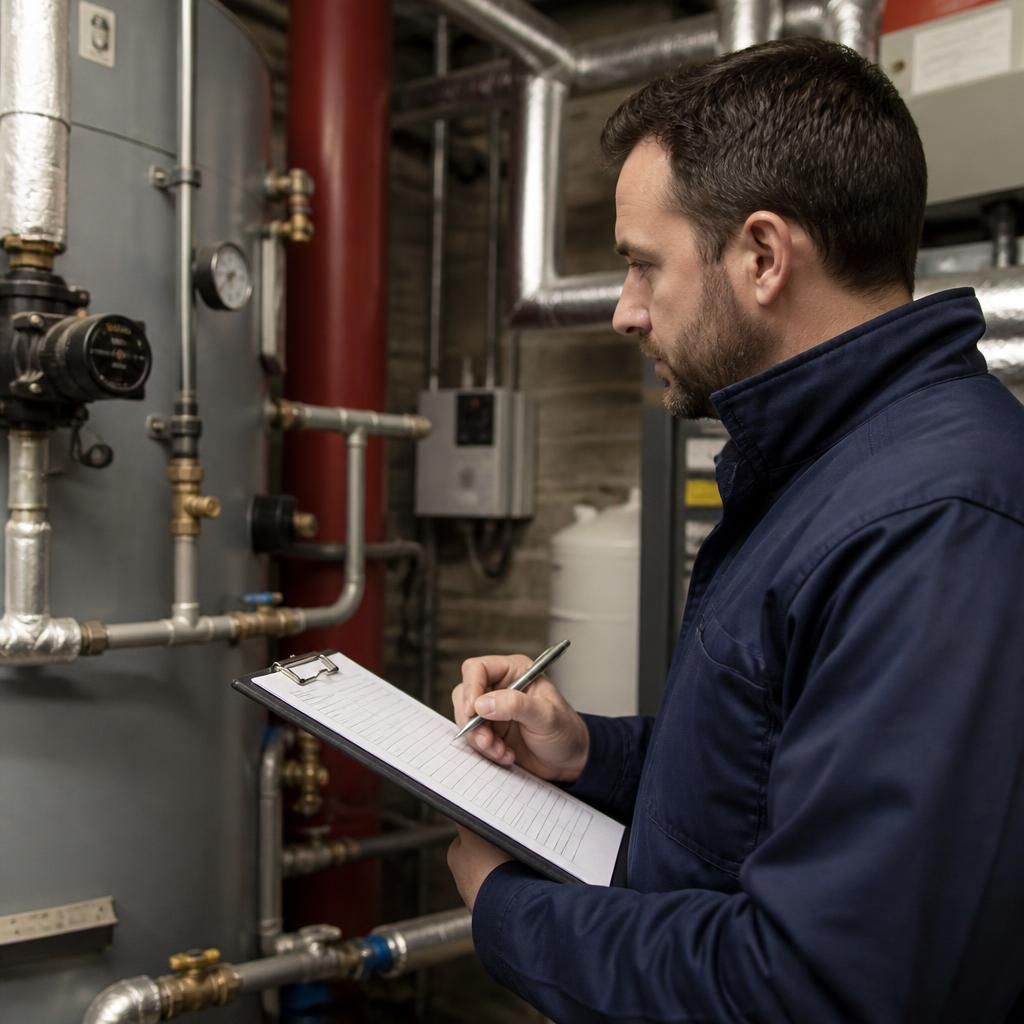
The person who carries out a legionella risk assessment should be competent to evaluate the whole water system, not simply take samples or record temperatures. Water sampling and laboratory analysis can provide useful evidence, but they do not by themselves demonstrate that someone can identify system hazards, assess exposure or recommend suitable controls.
When appointing an assessor, match their experience to the premises and its water services. Ask for evidence of comparable work, a clear assessment method and an explanation of what the inspection will cover. The assessor should be able to combine site observations, system information, maintenance records and monitoring data into a reasoned assessment that supports the duty holder’s decisions.
Discuss your legionella risk assessment requirements
Discuss your premises, existing water safety arrangements and assessment requirements with Blue Fish Water Management Ltd to determine the appropriate next step.