
What documents are needed for a legionella risk assessment?
Documents for a legionella risk assessment should include water system schematics or as-built drawings, an asset register, maintenance and inspection records, temperature and flushing logs, water sampling results, records of remedial work, and details of responsible personnel. Where available, include previous risk assessments, written control schemes, incident records and information about changes to the system, although the assessor will also verify the documented information through a site inspection.
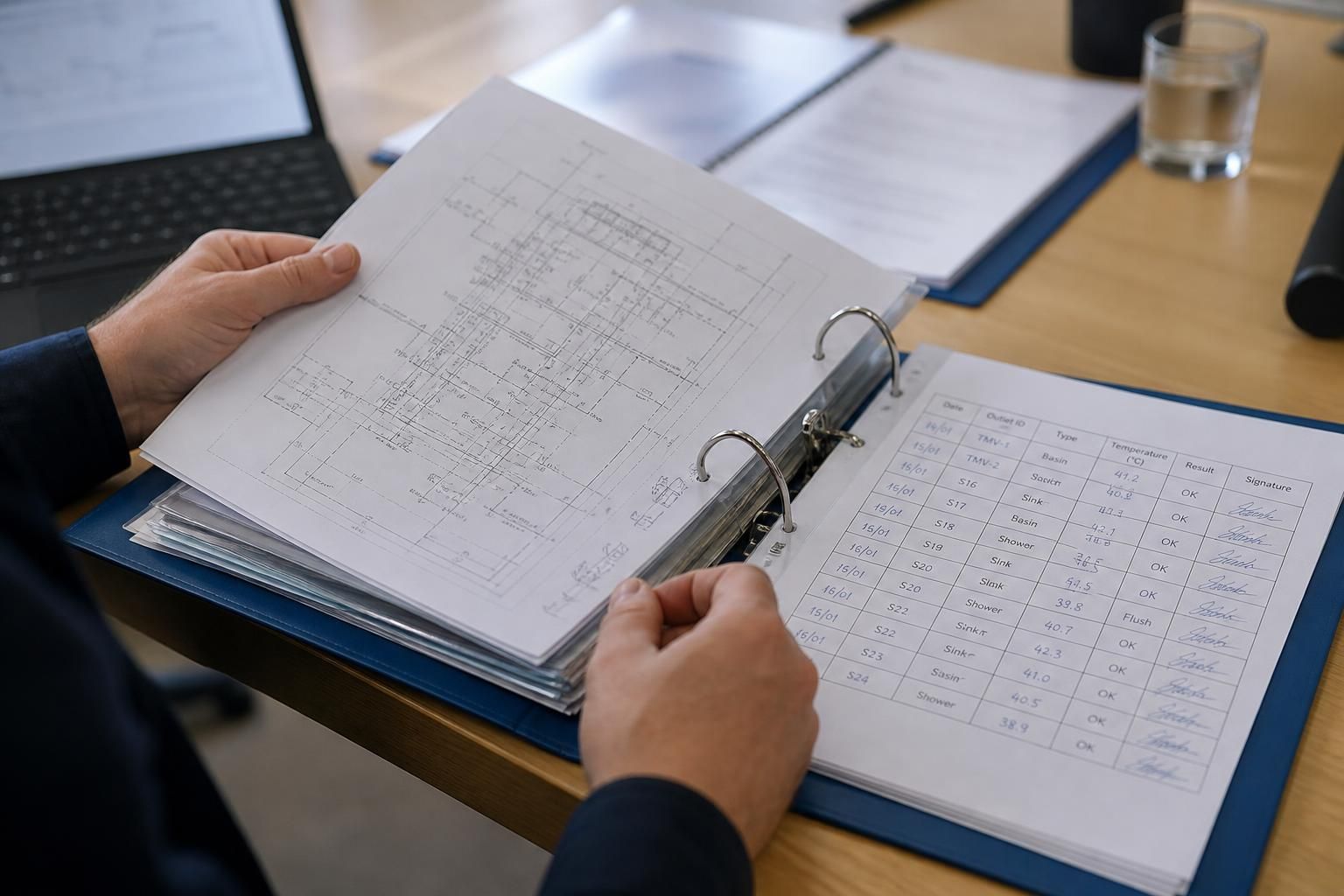
There is no single prescribed document pack for a legionella risk assessment. The assessor needs enough reliable information to understand how the water systems are designed, operated and managed, who may be exposed, and whether existing control arrangements are suitable. The documents listed in the initial brief form the core evidence; the following supporting information can make the assessment more accurate and prevent important risks being overlooked.
Management and responsibility records
Provide documents showing who has responsibility for managing water hygiene and which duties are delegated to employees, landlords, facilities teams or contractors. This may include:
- the organisation’s water hygiene policy or management procedure;
- job descriptions or appointment records for responsible persons and deputies;
- service specifications, contractor agreements and competence records;
- escalation procedures for failed controls, abnormal results or suspected cases of legionellosis; and
- records showing how staff are instructed to carry out relevant control tasks.
These documents help establish whether responsibilities are clearly allocated rather than assumed. They also allow the assessor to compare the written arrangements with what happens in practice.
Information about building use and occupants
The risk depends partly on how a building is used and who may come into contact with its water systems. Useful information includes room or building use, occupancy patterns, periods when areas are vacant, and any changes in use since the systems were installed. The assessor should also be told about people who may be particularly vulnerable to infection, such as those with impaired immunity, and about facilities where exposure could be more likely, including showers, spa facilities or equipment that produces an aerosol.
For workplaces with several occupiers, provide the relevant lease, facilities-management or responsibility information that explains which party controls shared water systems. This is particularly important where the building owner, managing agent and occupier each carry out different parts of the maintenance.
Design, installation and alteration information
Where available, include design specifications, commissioning information and records of significant alterations. Documents relating to plant replacement, extensions, changes to hot-water arrangements, redundant pipework or altered outlets can reveal conditions that may not be obvious from current operational records.
Information about storage vessels, calorifiers, pumps, secondary return arrangements, thermostatic mixing valves, treatment equipment and other system components may also be relevant. The assessor can then verify whether the installed arrangement corresponds with the available technical information and identify areas where the design creates stagnation, inadequate circulation or difficulty maintaining control.
Water treatment and chemical-control documents
If chemical treatment or other water treatment is used, provide the treatment specification, dosing or servicing instructions, product safety information and service records. The assessor may need to establish what the treatment is intended to control, where it is applied, how it is monitored and what action is required if it falls outside its operating limits.
Relevant chemical risk assessments and COSHH information should be available where hazardous substances are stored or used. These documents concern safe handling as well as legionella control, so they should be kept current and consistent with the equipment and chemicals present on site.
Incident, exception and change information
In addition to routine records, disclose unusual events that could have affected water hygiene. Examples include prolonged closure, loss of heating, major leaks, power interruption, changes to occupancy, construction work, complaints about water quality, or an outbreak investigation. The important point is to provide the context and the corrective action, not simply to supply a normal operating record.
Where a document is missing, incomplete or out of date, identify that fact rather than reconstructing information without evidence. An assessor can record the limitation, inspect the system and recommend proportionate steps to fill the gap. Concealing an absence of records can make the assessment less reliable.
How the documents are used
Documents support the assessment but do not replace a competent inspection. The assessor will compare the records with the installation, observe how outlets and plant are used, and discuss the control arrangements with relevant personnel. Discrepancies may indicate undocumented changes, unused sections, ineffective procedures or a need for further investigation.
A practical document pack should therefore be organised by building or system, dated where possible, and accompanied by a note explaining any missing information. Keeping the latest versions together makes it easier to demonstrate how risks are managed and to update the assessment when the building, equipment, occupancy or management arrangements change.
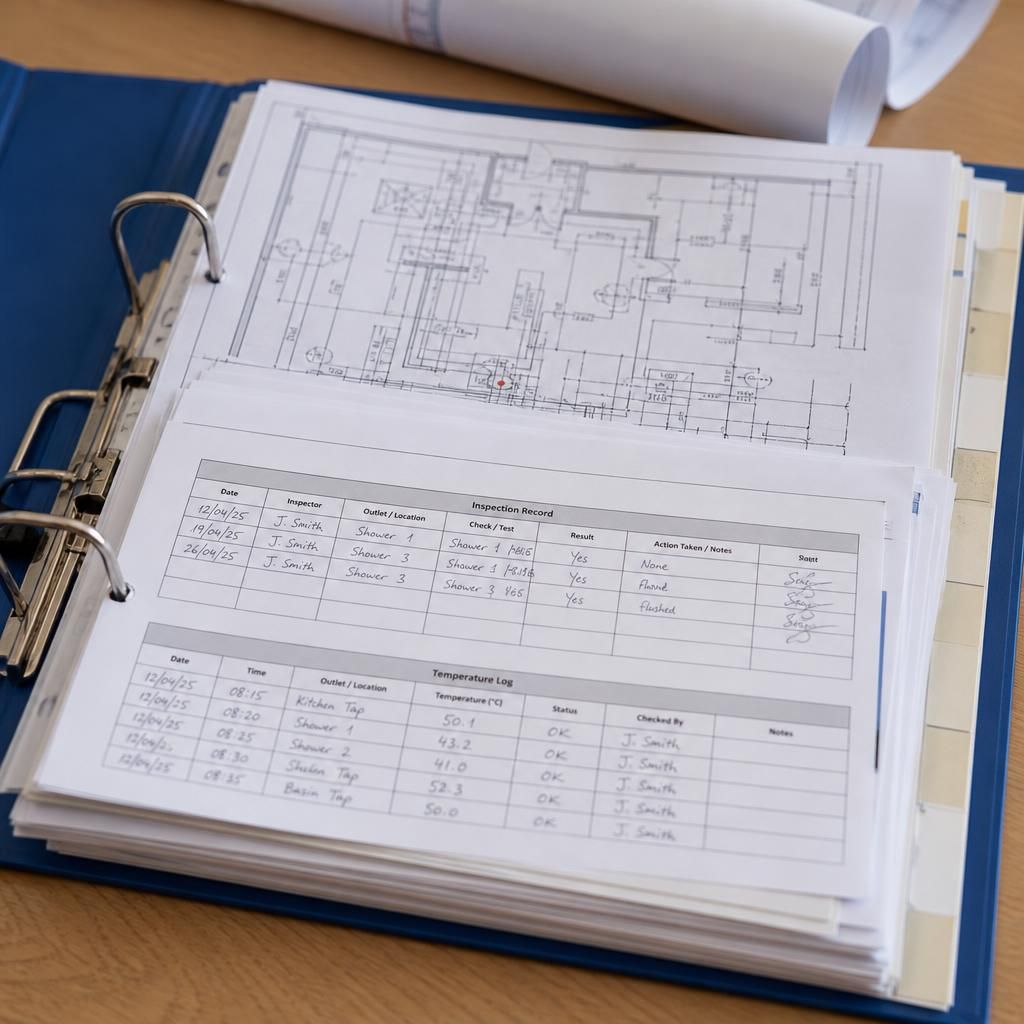
Monitoring records are most useful when each entry can be linked to a particular outlet, asset or system section. Temperature and flushing logs should therefore identify the location, date, person completing the check, result recorded and any action taken when the expected control was not achieved. Where measuring equipment is used, relevant calibration or verification records can also help demonstrate that readings are dependable.
This level of detail allows the assessor to distinguish a complete control record from a general statement that checks have been carried out. It also helps trace recurring issues, such as one outlet that repeatedly records an abnormal temperature, and provides clearer evidence for deciding whether further investigation or remedial work is needed.
Prepare for your legionella risk assessment
If you are unsure whether your existing records are sufficient, speak to Blue Fish Water Management Ltd about preparing for a legionella risk assessment and identifying any important information gaps.