
How is competence assessed during legionella risk assessment training?

Competence is assessed by comparing a learner’s performance with defined learning outcomes and the level of judgement required for a genuine legionella risk assessment. A competent learner must be able to interpret the water system, recognise significant risks, select proportionate controls and justify their conclusions using relevant guidance and evidence. Completing a course or receiving a certificate alone does not prove competence for every type of premises or water system.
Training providers usually assess several connected areas rather than relying on a single knowledge test. These areas may include:
- Technical understanding: knowledge of legionella hazards, conditions that encourage bacterial growth, routes of exposure and the purpose of key control measures.
- System interpretation: the ability to understand how water is supplied, stored, heated, distributed and used, including identifying dead legs, low-use outlets, temperature concerns and vulnerable users.
- Risk judgement: the ability to distinguish significant risks from minor observations and decide which findings require action, further investigation or routine monitoring.
- Control knowledge: understanding how responsibilities, monitoring, maintenance, cleaning, disinfection and remedial work fit into a suitable control scheme.
- Reporting: the ability to explain conclusions clearly, link recommendations to identified risks and make the report useful to the responsible person.
A sound assessment also examines whether the learner knows the limits of their own role. For example, a person may recognise that a system needs specialist engineering input, sampling or remedial work without attempting to make an unsupported technical judgement. Recognising missing information is part of competence. A defensible assessment should identify assumptions, explain where evidence is incomplete and state what needs to be checked before controls are accepted.
Assessment criteria should be linked to the legal and technical framework relevant to the work. This commonly includes the Health and Safety at Work etc. Act, the Control of Substances Hazardous to Health Regulations, the relevant duties under the Management of Health and Safety at Work Regulations, the Approved Code of Practice L8 and HSG274 technical guidance. L8 and HSG274 help define good practice, but training should also test whether the learner can apply guidance to the particular system rather than reproduce its wording.
Practical competence is often judged through the quality of decisions made during a realistic scenario. A learner may be expected to identify the responsible person and other duty holders, establish the scope of the assessment, gather relevant system information and determine whether existing controls are suitable. The assessor will look for reasoning, not just a list of hazards. Recommendations should be proportionate, prioritised and capable of being understood by the organisation responsible for implementing them.
Feedback is an important part of the assessment process. Where a learner overlooks a control failure or reaches a conclusion without adequate evidence, the tutor should explain the gap and allow the learner to demonstrate improvement where the course structure permits. A robust process should make clear whether the learner has passed, needs further development or requires additional supervised experience. The assessment record should identify the learning outcomes covered and retain evidence of the result.
There is a difference between course competence and workplace competence. Course assessment can confirm that a learner has reached the required standard within the training exercise. Workplace competence develops through applying that knowledge to different buildings, occupants, water systems and organisational arrangements. Someone conducting assessments independently may therefore need relevant experience, suitable supervision and an understanding of the types of system they are being asked to assess.
When selecting legionella risk assessment training, organisations should ask how competence is measured, what practical evidence is required, who conducts the assessment and how unsuccessful or borderline outcomes are handled. They should also check that the course reflects the learner’s intended duties. A short awareness course may be appropriate for general understanding, but it should not be treated as evidence that a person can independently carry out and defend a detailed legionella risk assessment.
For employers and responsible persons, the final decision should consider more than the certificate. Training records, previous experience, supervised work, technical understanding and the complexity of the premises all contribute to a competent-person assessment. Continuing development may also be necessary when guidance changes, when the person takes on unfamiliar systems or when reviews identify weaknesses in the quality of completed assessments.
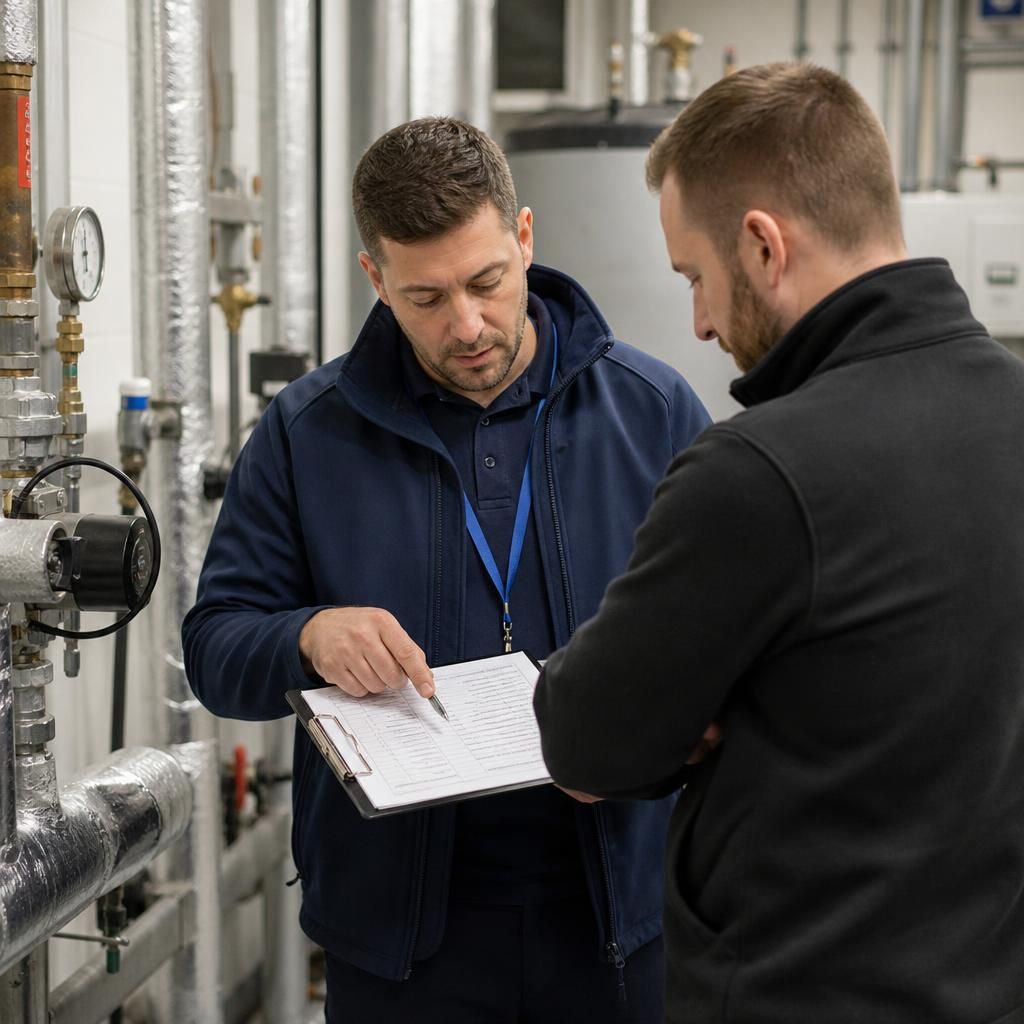
Competence is assessed more reliably when the assessment process itself is controlled, transparent and based on criteria set before the learner’s work is reviewed. The assessor should be able to show which learning outcomes were tested, what evidence was considered and why the result was reached, rather than relying on a general impression of the learner’s performance.
This usually involves reviewing the completed assessment against a structured marking scheme and recording any material omissions, errors or unsupported decisions. The assessor’s own knowledge of legionella control and risk assessment is also important, particularly where the learner’s work involves a complex or unusual water system. For borderline results, a further discussion, supplementary evidence or independent review may help establish whether the learner has met the required standard.
Explore Legionella Risk Assessment Training Options
Review your team’s responsibilities and choose legionella risk assessment training that matches the systems and decisions they will be expected to manage. Blue Fish Water Management Ltd can help you identify a suitable training route for your organisation.