
Does legionella risk assessment training cover HSG274 and L8?
Yes. Suitable legionella risk assessment training should explain how the principles of the Health and Safety Executive’s HSG274 guidance and the requirements of the Approved Code of Practice L8 apply when identifying, evaluating and controlling legionella risks.
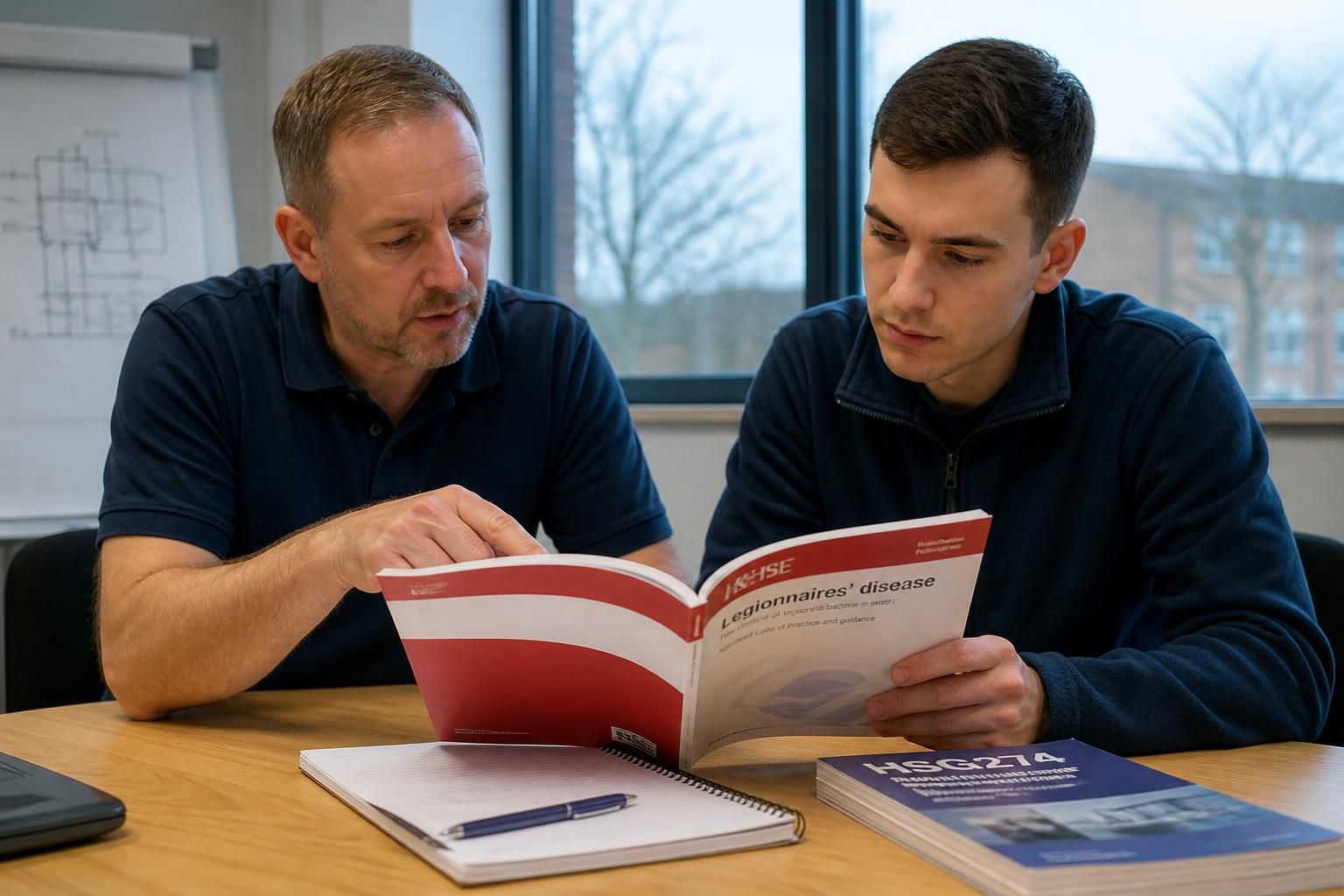
Good legionella risk assessment training should cover both HSG274 and L8, but it should explain how to apply them rather than simply list their titles. The Health and Safety Executive’s Approved Code of Practice L8 sets out the legal and organisational expectations for controlling legionella risks, while HSG274 provides technical guidance for assessing and managing risks in different types of water system.
L8 is particularly important because it describes the responsibilities of dutyholders and the arrangements needed to manage risk. Training should explain how organisations identify who has responsibility for water systems, appoint competent assistance where necessary, implement suitable control measures, maintain records and review their arrangements. It should also clarify that following an approved code is not the only possible way to comply with health and safety law, but a departure from its guidance needs to be properly justified.
HSG274 gives more detailed technical information to support the assessment and control process. Depending on the systems covered by the course, this may include:
- hot and cold water systems, including storage, distribution and outlets;
- evaporative cooling systems and cooling towers; and
- other risk systems and equipment that may create conditions suitable for legionella growth or transmission.
A comprehensive course should help learners use the relevant part of HSG274 when gathering information about a system. This includes understanding the system design, water temperatures, storage arrangements, distribution routes, points of use, dead legs, infrequently used outlets, vulnerable users and potential exposure routes. The learner should understand that a risk assessment must reflect the actual system and its use, rather than rely on a generic template.
Training should also cover how to evaluate the findings. This normally involves considering whether conditions exist that could allow legionella to multiply, whether water droplets or aerosols could expose people, and whether any individuals may be especially susceptible to illness. The assessment should then lead to proportionate control measures, clearly assigned responsibilities and a method for checking that controls remain effective.
In practical terms, course content should address the relationship between assessment and ongoing control. Relevant topics can include:
- temperature control and the limitations of relying on temperature alone;
- cleanliness, scale, corrosion, sludge and biofilm;
- flushing of infrequently used outlets;
- inspection, cleaning and maintenance;
- monitoring schedules and interpretation of results;
- water treatment and remedial action where appropriate;
- management of changes to systems, premises or occupancy; and
- reviewing the assessment after incidents, alterations or evidence that controls are not working.
The course should explain what a useful written risk assessment contains. This may include a description of the water systems, an evaluation of the hazards, the people who could be exposed, existing precautions, further actions, responsible persons, completion dates and arrangements for review. Learners should be taught to distinguish between a hazard identified during a site inspection and a control measure that has been selected, implemented and verified.
HSG274 and L8 also need to be considered alongside other relevant sources of information. Training may refer to manufacturers’ instructions, system drawings, treatment records, sampling results, maintenance information and specialist advice. These sources can help establish how equipment operates and whether planned controls are suitable, but they do not remove the need for a site-specific professional judgement.
Most importantly, covering the documents does not by itself make someone competent to carry out every type of assessment. A course should state its scope clearly, including the systems and level of complexity it addresses. It should provide opportunities to interpret technical information, identify deficiencies, justify recommendations and produce or review assessment documentation. More complex systems may require additional technical knowledge, supervised experience or specialist input.
Assessment of learning can include written questions, case studies, practical exercises, document review or evaluation of a completed risk assessment. The method should test whether the learner can apply HSG274 and L8 to realistic circumstances, not merely recall terminology. A certificate confirms completion of the course; it does not replace the need for suitable experience, ongoing development and evidence that the person can perform the role to the required standard.
When comparing courses, check whether the syllabus names the relevant sections of HSG274 and explains their application to risk assessment. It is also sensible to ask whether the course covers the management duties in L8, site-based assessment techniques, written reporting, control verification and the limits of the learner’s competence. Those details provide a better indication of value than a course title alone.
“Covering” HSG274 and L8 should mean more than mentioning them in the course outline. Training materials should identify which parts of HSG274 are relevant to the water systems being studied and show how the guidance is used alongside L8 when making decisions about responsibility, control and review.
It is also worth checking how the course keeps its references current. Ask whether learners receive the applicable guidance documents or source references, how changes to published guidance are handled, and whether the assessment tests practical interpretation rather than simple recall. This helps distinguish meaningful coverage from a brief overview of the terminology.
Review your legionella risk assessment training options
Use these points to compare legionella risk assessment training options and identify a course whose scope, assessment method and supporting guidance match your organisation’s needs.