
How often should a legionella risk assessment be reviewed?

The review interval for a legionella risk assessment should be set as part of the water safety management plan and supported by documented evidence. A formal review confirms whether the assessment still describes the premises accurately, whether the control scheme remains suitable and whether the arrangements assigned to responsible people are being followed in practice.
UK guidance does not treat a risk assessment as a permanent document. The Health and Safety Executive’s Approved Code of Practice L8 and associated HSG274 guidance expect dutyholders to keep the assessment under review and update it when it no longer reflects the risks present. The date of the next planned review should be recorded, together with the person responsible for completing it and the reasons for any change to the planned interval.
A proper review should examine:
- the description of the hot and cold water systems, including storage vessels, distribution pipework, outlets and infrequently used sections;
- the current use of the premises and the groups who may be exposed, including people who may be more susceptible to legionnaires’ disease;
- temperature control, disinfection arrangements, flushing, cleaning, monitoring and sampling requirements;
- records of temperature checks, maintenance, water treatment, sampling results, faults and corrective actions;
- whether the written control scheme matches the system and procedures operating on site;
- the named roles, lines of communication, training and competence of those carrying out or overseeing control measures; and
- any recommendations from the previous assessment that remain incomplete or require further verification.
A review is more than checking that the assessment document has a recent date. The assessor should compare the written information with the physical installation and available records. For example, an outlet shown on a schematic may have been removed, a seldom-used area may now be occupied, or a maintenance procedure may have changed. These differences can affect the accuracy of the risk assessment even if the water system appears broadly unchanged.
Routine monitoring and sampling do not replace a formal review. Daily, weekly or monthly checks provide evidence about how controls are performing, whereas the review considers whether the overall assessment, control scheme and management arrangements remain appropriate. Results should therefore be considered together rather than viewed in isolation. Repeated temperature failures, recurring remedial work or unexplained sampling results may indicate that the underlying assessment needs closer examination.
The outcome should be clearly recorded. Where the existing assessment remains suitable, the review record should confirm the date, evidence considered, people involved and next planned review. Where it is no longer adequate, the relevant sections should be amended or a new assessment commissioned. Changes should also be communicated to the people responsible for operational controls, and any outstanding actions should have an owner and target date.
Responsibility for keeping the assessment current normally sits with the dutyholder or appointed responsible person, although a competent external specialist may carry out the assessment or review. The dutyholder remains responsible for ensuring that the assessor has access to the premises, system information, maintenance records and relevant monitoring results. A review is only useful if its recommendations are understood and implemented.
For organisations managing several buildings or complex water systems, a documented review schedule can help coordinate assessments, control schemes, testing records and remedial actions. Blue Fish Water Management can support this process through legionella risk assessments, compliance audits, water testing and system monitoring, helping businesses maintain evidence that their water safety arrangements remain under active review.
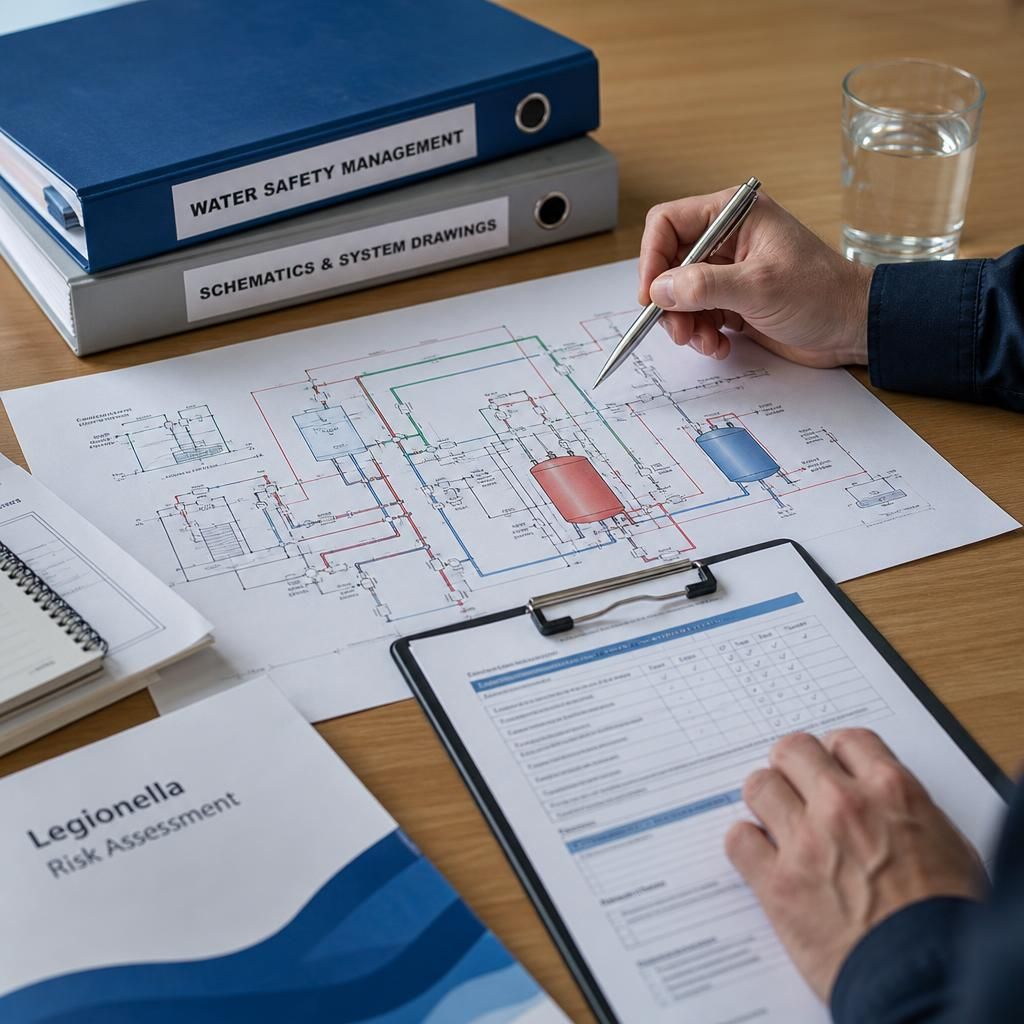
The review frequency should reflect the level of risk rather than relying only on a standard calendar date. A building with a complex water system, multiple storage vessels, healthcare-related activities or occupants who may be particularly vulnerable may justify a shorter planned interval than a straightforward, stable installation.
For organisations with several premises, this risk-based approach helps prioritise attention where it is most needed. Each site should have its own review date and rationale, rather than assuming that one assessment or one review cycle applies equally across the whole portfolio. The rationale should be clear enough for the dutyholder to explain why the chosen interval remains appropriate.
Discuss your legionella risk assessment review
If you need to clarify the scope, evidence or documentation required for your next review, discuss your circumstances with Blue Fish Water Management. Their team can advise on the appropriate assessment or review process for your premises.