
What information is needed before a legionella risk assessment?
Before a legionella risk assessment, the assessor needs details of the premises, how it is used and occupied, the people who may be exposed, and the person responsible for managing water safety. Information about water systems and outlets, schematics or asset records, inspection and monitoring records, previous test results, incidents, alterations and existing control measures helps the assessment identify hazards accurately.

The assessor needs enough reliable information to understand how water systems operate in practice, how they are managed and whether the documented arrangements reflect the site. The most useful preparation is a complete information pack, access to relevant plant and outlets, and someone available to explain any unusual features or recent changes.
Provide the correct scope for the assessment. Confirm which buildings, floors, departments, plant rooms, welfare facilities and external areas are included. If the assessment covers only part of a site, identify the boundary clearly and explain how connected systems outside that boundary are managed. Shared facilities, leased areas, vacant rooms and contractors’ areas should not be overlooked, as they may contain outlets or equipment connected to the same water systems.
Identify key contacts and responsibilities. The assessor will normally need to speak with the person who manages water hygiene, as well as facilities staff, maintenance personnel or contractors who understand the installation. Provide relevant contact details and clarify who can authorise remedial work, arrange access and approve changes to operating procedures. Where responsibilities are divided between a landlord, managing agent, occupier and contractor, set out those divisions before the visit.
Explain how the premises operate. Information about occupancy patterns can be made more useful by noting periods of low or intermittent use, seasonal shutdowns, shift changes, restricted-access rooms and areas that are rarely occupied. Also explain whether water is used for healthcare, care provision, manufacturing, research, accommodation, leisure or other specialist purposes. These activities may affect the consequences of a failure in control and the precautions needed for particular parts of the system.
Describe unusual or higher-risk equipment. In addition to the main hot and cold water services, flag equipment such as showers, spray taps, safety showers, eye-wash stations, spa pools, cooling equipment, humidifiers, decorative water features or process systems that can create an aerosol. Identify equipment that is isolated, redundant, temporarily out of service or awaiting removal. This helps the assessor decide whether it forms part of the assessment and whether stagnant sections or dead legs require attention.
Make technical information available where it exists. Useful documents may include commissioning information, operation and maintenance manuals, water treatment specifications, valve schedules, asset registers, plant photographs and records showing how outlets or tanks are connected. Drawings do not need to be perfect to be helpful, but any known inaccuracies should be pointed out. Where no schematic is available, the assessor may need additional time to trace pipework and establish how storage, distribution and secondary circulation are arranged.
Prepare evidence of day-to-day control. The assessment is concerned with how the system is actually managed, not only what a policy says. Provide relevant written procedures, inspection sheets, temperature monitoring records, cleaning and disinfection certificates, sampling reports, contractor reports and records of corrective actions. It is also useful to show how missed checks, abnormal readings and unresolved defects are recorded and escalated. If a task is completed by an external contractor, include the agreed scope and the information passed back to the responsible person.
Explain changes since the last assessment. Tell the assessor about refurbishments, extensions, changes in occupancy, new equipment, alterations to hot-water generation or storage, pipework modifications and changes to maintenance arrangements. A system can present a different risk after a room is repurposed, an outlet is added or a building becomes partially vacant. Records of these changes help distinguish a current risk from an obsolete description of the site.
Arrange practical access. The assessor may need to inspect tanks, calorifiers, water heaters, pumps, thermostatic mixing valves, shower heads, little-used outlets, service risers and accessible sections of distribution pipework. Arrange keys, permits, escorts, isolation information and any required personal protective equipment in advance. If an area cannot be entered, explain why and identify alternative evidence; inaccessible plant should not be assumed to be satisfactory.
Record known problems honestly. Include recurring temperature failures, poor flow, scale, corrosion, leaks, blocked outlets, unexplained odours, access difficulties and equipment that cannot be maintained as intended. Previous incidents or positive test results should be accompanied by details of the investigation and subsequent action where available. Concealing or omitting a known issue can leave the assessment based on incomplete information and may result in unsuitable recommendations.
What happens if information is missing? A missing drawing or incomplete record does not necessarily prevent an assessment. The assessor can identify limitations, verify information during the site inspection and recommend further surveying or record creation. However, the final assessment should distinguish confirmed facts from assumptions and should state where additional evidence is needed before a risk can be considered adequately controlled.
Before the visit, a simple document check can therefore include the agreed scope, current asset information, water-system records, monitoring evidence, maintenance and treatment documents, details of changes, and contact information for everyone with a relevant responsibility. Clear, current information allows the assessment to focus on the real condition and use of the system rather than reconstructing basic facts from incomplete records.
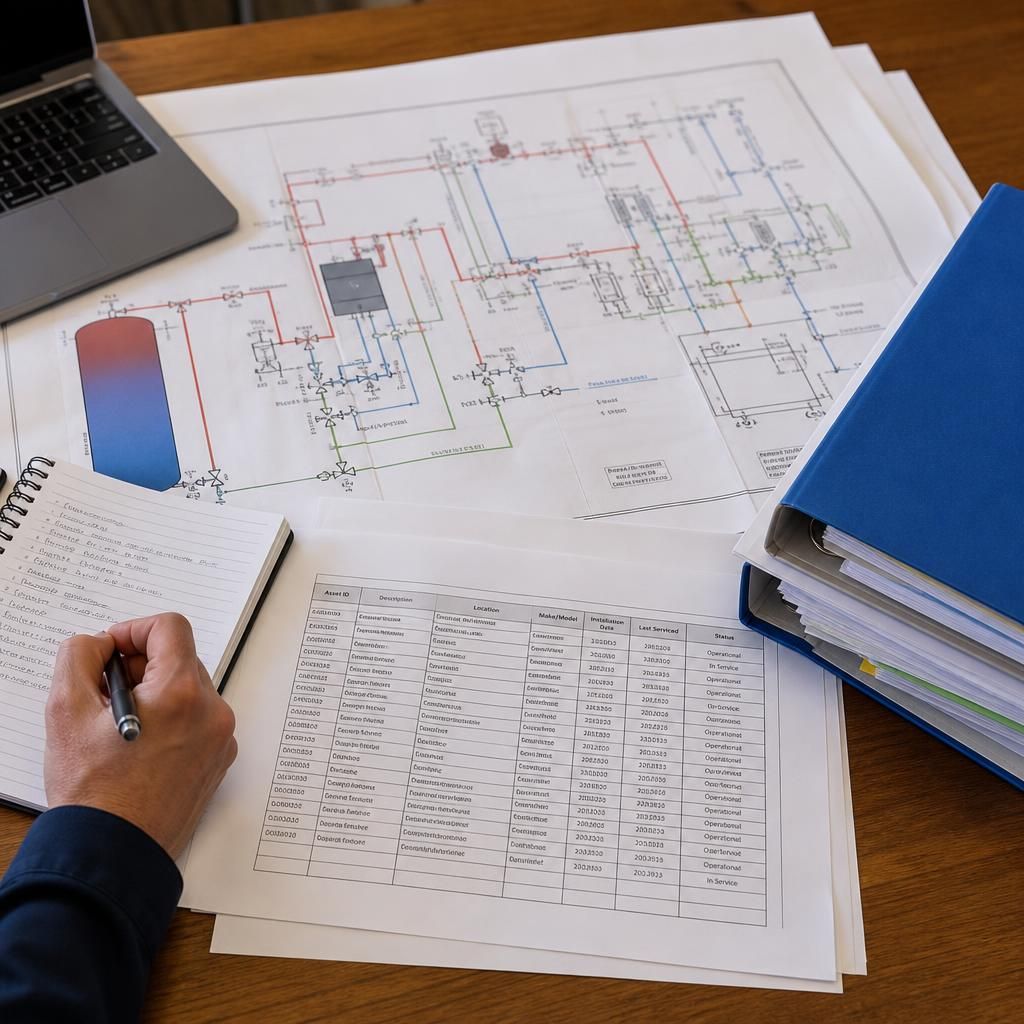
Document dates and status are important before a legionella risk assessment because outdated records can describe a system that no longer exists. Mark schematics, asset registers, procedures and monitoring logs with their issue date, identify superseded versions, and note when each record was last checked against the site.
Where records conflict, preserve both the documented position and the current site evidence rather than silently correcting one. This gives the assessor a clear audit trail and highlights areas where system information needs verification during the assessment.
Prepare for your legionella risk assessment
If you are preparing for a legionella risk assessment, Blue Fish Water Management can help identify the information and site access needed for a thorough review. Contact the team to discuss your premises and assessment requirements.