
Can one Legionella risk assessment schedule cover multiple sites?
Yes, one Legionella risk assessment schedule can cover multiple sites, provided it clearly identifies each location and records its own assessment date, findings, control measures and review requirements. It should operate as a coordinated register rather than replacing the need for a site-specific risk assessment at every premises.

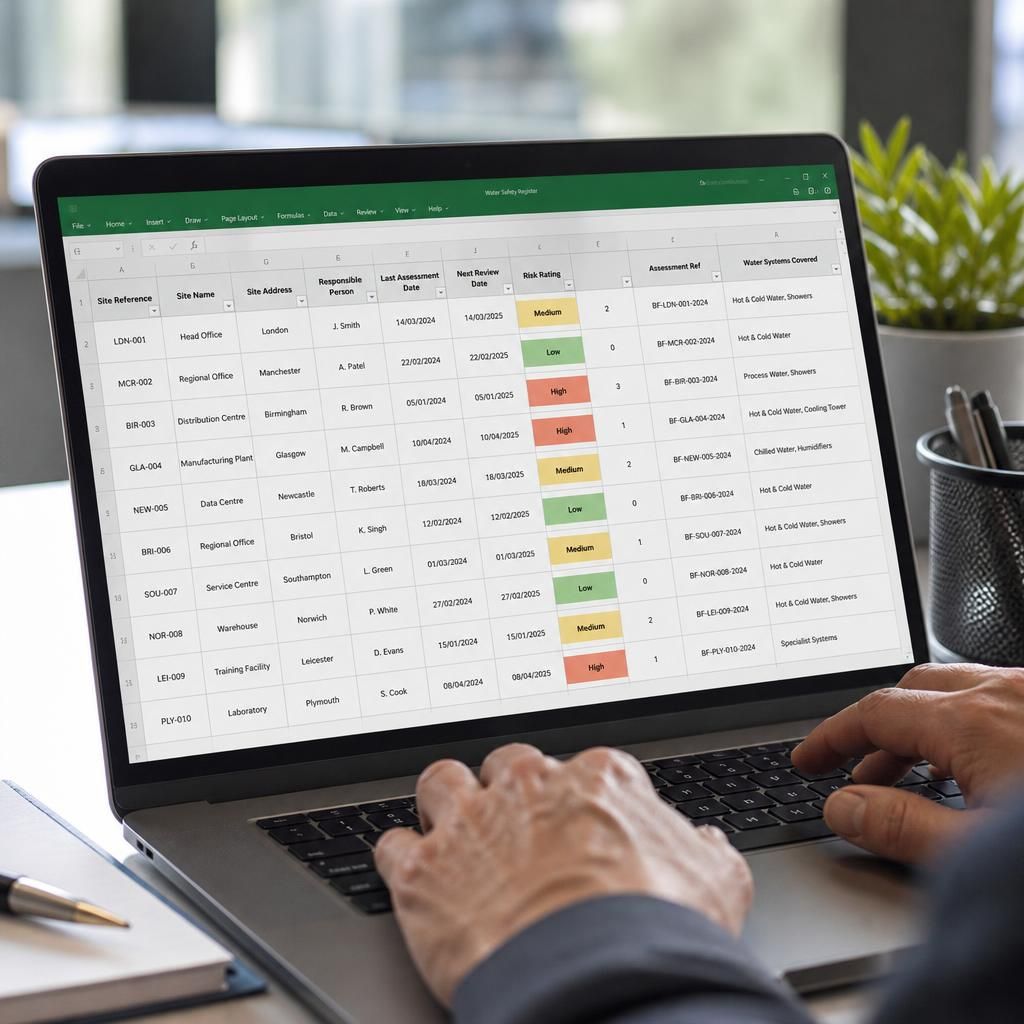
One coordinated legionella risk assessment schedule can cover a multi-site organisation, but it must be designed as a controlled register of separate site obligations. The schedule should make it possible to see which premises have been assessed, what risks were identified, which actions remain open and when each assessment or review is due.
A single document is appropriate where it improves oversight without obscuring differences between locations. It should not treat a group of premises as one water system. Each site may have different building uses, occupancy patterns, water services, responsible persons, vulnerable occupants, contractors and operational risks. Those differences need to remain visible in the schedule and in the supporting risk assessments.
A suitable multi-site schedule should include:
- the full site name, address and any internal reference used by the organisation;
- the person or team responsible for water safety at that location;
- the date of the current assessment and the date of the previous assessment, where relevant;
- the assessor and the document reference for the underlying assessment;
- the principal water systems and assets considered, such as hot and cold water services, showers, storage vessels or specialist systems;
- the significant findings and the level of action required;
- actions allocated to named people, with target dates and completion status;
- the required review date or review interval; and
- any event that may require an earlier review, such as refurbishment, a change of use or alterations to the water system.
The schedule can contain common information at group level, such as the organisation’s water safety policy, reporting route, document-control method and escalation process. However, shared procedures should not replace site-level details. For example, a common flushing procedure may apply across several premises, but the schedule should still show which outlets or areas are included at each site and who is responsible for carrying out and recording the work.
It is useful to separate the schedule into a central summary and site records. The summary gives managers an overview of due dates, overdue actions and recurring issues. Each site record then links to, or clearly identifies, the complete assessment, schematic information, monitoring records, test results and remedial-work evidence. This structure reduces duplication while preserving an audit trail.
Before combining sites, check whether the locations genuinely share enough governance and operational control. A central schedule is easier to manage when the same organisation controls the premises, uses consistent procedures and has a defined route for receiving and acting on findings. Separate schedules or clearly divided sections may be more suitable where sites are managed by different legal entities, use different contractors, have substantially different water systems or operate under separate management arrangements.
The assessment cycle should also reflect risk rather than rely solely on a fixed calendar date. A site with complex water services or higher exposure may need more frequent monitoring and closer management than a simple, lightly occupied premises. A change to one site should not automatically alter every date in the group schedule, unless the organisation has evidence that the change affects the wider water safety arrangements.
Central oversight does not remove local responsibilities. The organisation should define who maintains the master schedule, who keeps each site’s records accurate, who verifies that control measures are being completed and who reviews outstanding actions. Changes in personnel should be recorded so that responsibility does not depend on informal knowledge.
Information from monitoring and testing should be reviewed alongside the schedule, not filed separately without reference to it. Results that indicate a control failure, repeated temperature problems, inadequate outlet use or other concerns may require corrective work and a reassessment of the affected site. The schedule should record the issue, the decision taken, supporting evidence and the date on which the action was closed or the next review was arranged.
A multi-site schedule should therefore be treated as a live management tool rather than a one-off list of assessment dates. Periodic checks should confirm that every premises remains represented, documents are current, actions have owners and completed work has been verified. A specialist water hygiene provider can help organisations develop the schedule, assess individual sites and align monitoring, testing and remedial records with the findings from each assessment.
A multi-site schedule should distinguish between separate premises and connected water systems. Buildings on the same campus may have shared storage, distribution pipework or plant, while other buildings may operate entirely independent systems. The schedule should record these relationships so that an assessment covers the correct physical system and does not duplicate, omit or incorrectly combine assets.
Where systems are interconnected, identify the shared assets and show which buildings, outlets or areas they serve. Where systems are separate, retain distinct assessment records even if the organisation manages both locations under one schedule. This system-based structure helps link monitoring results, remedial actions and review decisions to the part of the estate they actually affect.
Discuss your multi-site Legionella risk assessment schedule
Discuss your proposed multi-site schedule with Blue Fish Water Management Ltd to confirm that its structure supports clear accountability, traceable records and effective review decisions across the estate.