
How should legionella risk assessment review dates be recorded?

Legionella risk assessment review dates should be recorded as part of a controlled, traceable record that shows when the assessment was considered, what prompted the review and what action followed. The record should allow a responsible person, auditor or enforcing authority to distinguish a routine review from a reassessment prompted by a change or an incident.
Use one central register or document-control system for all assessments. Each entry should identify the relevant premises, water system or assessment scope and link to the supporting risk assessment, survey findings and action plan. This prevents dates being held only in email correspondence, isolated spreadsheets or individual diaries, where they can be difficult to retrieve or verify.
The record should distinguish between key events rather than relying on a single date field. Depending on the organisation’s process, this may include:
- the date the review was planned;
- the date the review was actually completed;
- the date any revised assessment was issued or approved;
- the date resulting control measures were completed or checked; and
- the date on which a further review was triggered by a change in circumstances.
Where a planned review is not completed by its intended date, retain the original entry rather than overwriting it. Add the revised position, the reason for the delay, any interim controls and the person responsible for progressing the matter. This creates an audit trail and shows whether the water system continued to be managed appropriately while the review was outstanding.
A review-date record should also explain the scope of the review. For example, note whether the assessment was confirmed as still suitable, amended following changes to plant or building use, or replaced after new information became available. If no changes are identified, record that conclusion explicitly. A blank amendment field does not demonstrate that the assessment was actively reviewed.
Changes that may require a new entry include alterations to the water system, changes in occupancy or use, changes to vulnerable occupants, refurbishment, control failures, an outbreak or suspected case, and significant findings from monitoring or sampling. The record should cross-reference the relevant evidence, such as commissioning information, maintenance records, test results, incident documentation or meeting minutes.
For paper records, use a bound register or a controlled form with sequential entries and secure storage. Do not erase or obscure an earlier entry; correct mistakes with a dated, attributable amendment. For electronic records, use access controls, automatic audit history or equivalent safeguards, and restrict editing of completed records. Any exported or printed copy should show when it was produced and be checked against the controlled record.
Review records should be retained with the wider legionella control documentation in line with the organisation’s document-retention policy and any applicable contractual or regulatory requirements. They should be readily available to the person responsible for water safety and to anyone carrying out compliance checks. Periodic checks of the register can identify overdue entries, assessments without supporting evidence and actions that have not been closed.
There is no value in recording a date without recording the decision attached to it. A useful entry demonstrates that the assessment was examined, identifies whether further work was required and provides evidence that the resulting actions entered the organisation’s water-management process.
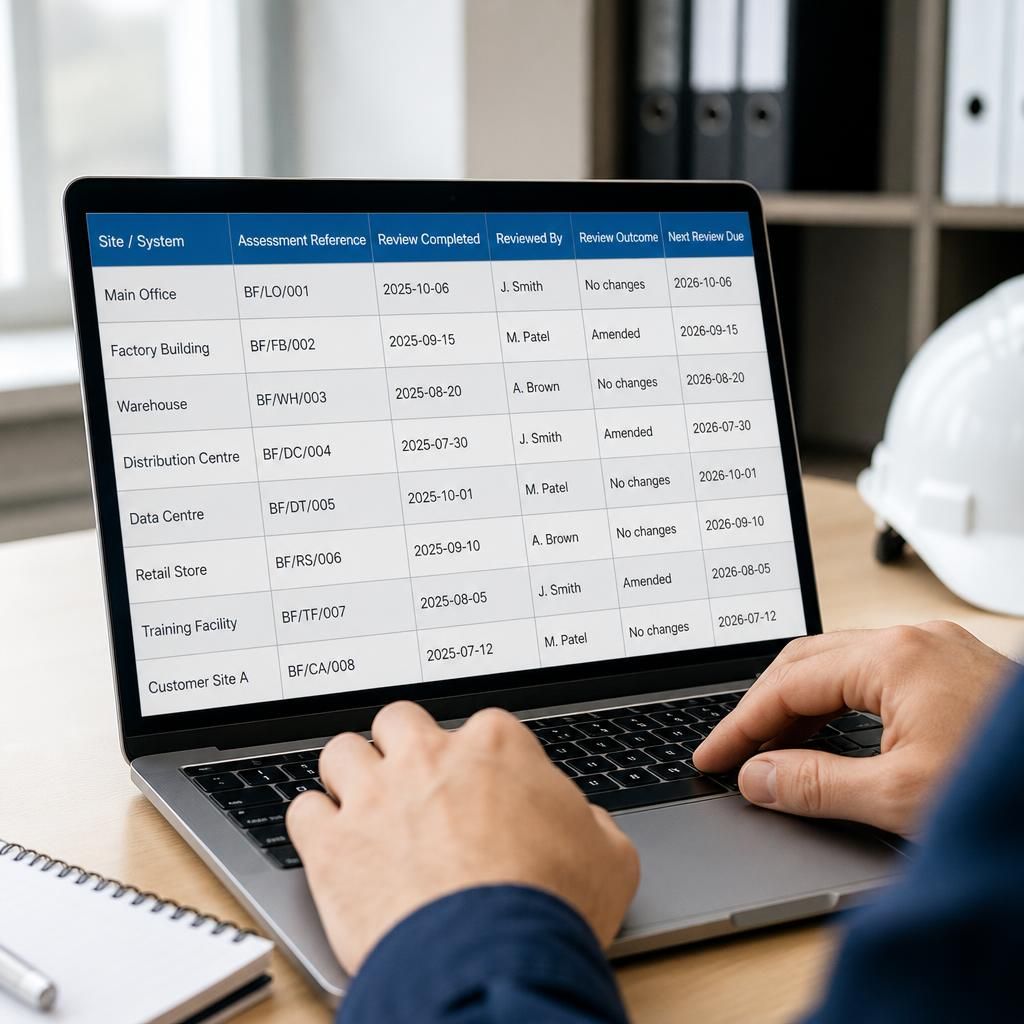
Use an unambiguous date convention for every legionella risk assessment record. Numeric dates such as 06/10/2026 can be misread, so use the ISO format 2026-10-06 or write the date in full, such as 6 October 2026. Apply the same format to the completed review date, approval date and planned next review date. Consistency makes electronic searches, exported reports and audits less vulnerable to date errors.
Need advice on recording legionella review dates?
If you need to check whether your legionella review-date process provides a clear, auditable record, speak to Blue Fish Water Management Ltd about practical water hygiene and compliance advice for your organisation.