
What records should an organisation keep for L8 compliance?
An organisation should retain its legionella risk assessment, written scheme, monitoring and inspection logs, water testing results, maintenance records, remedial action reports, incident records and staff training records. Records should be accurate, dated, clearly assigned to the relevant system or area, and retained in line with the organisation’s written scheme so they demonstrate that L8 control measures are being implemented and reviewed.

L8 compliance records should provide a clear, chronological audit trail showing how an organisation has identified legionella risks, applied its control scheme, checked whether controls were effective and dealt with any failures. Records are useful only when another competent person can understand what was checked, where, by whom, when, against which limit and what happened afterwards.
Retention periods
HSE guidance states that records of monitoring, inspections, tests and checks, together with their results, should generally be kept for at least two years. Organisations should confirm the precise retention period in their written scheme and document-control policy. The current risk assessment and written scheme should remain readily available, while superseded versions should be retained where they help demonstrate how the water system and its controls have changed over time.
Longer retention may be appropriate where a site has a complex water system, vulnerable occupants, a history of control failures, contractual requirements or an ongoing investigation. Records should not be destroyed simply because a service visit has been completed if they are still needed to explain a trend, justify a decision or demonstrate that an earlier problem was resolved.
Information that makes a record auditable
- the site, building, water system, plant item or outlet to which the entry relates;
- the date and, where relevant, time of the activity;
- the person who carried out the check and their role or competence;
- the method, equipment or procedure used;
- the result, including the relevant control limit or acceptance criterion;
- any limitation affecting the inspection, such as an inaccessible outlet or unavailable plant; and
- the action taken when the result was unsatisfactory, including the person responsible and the completion date.
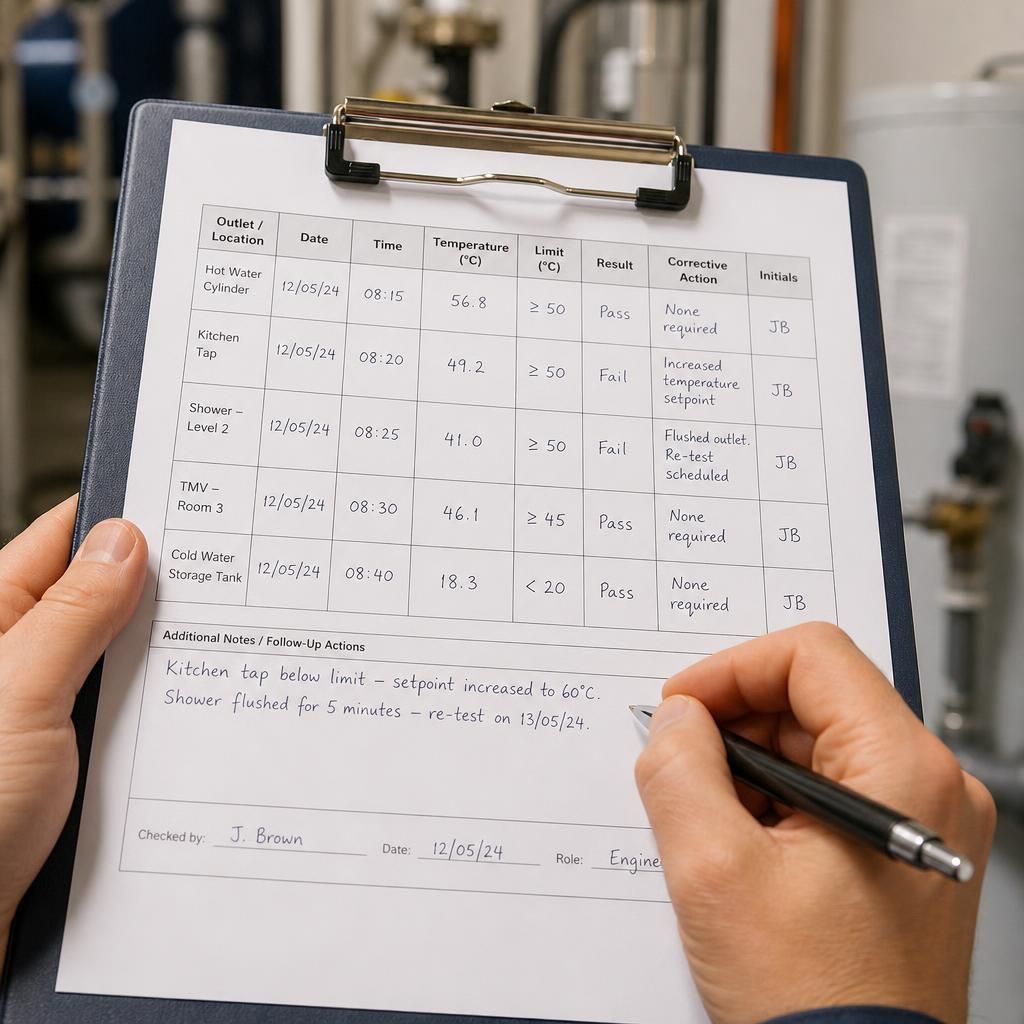
A tick-box stating that a task was completed may be insufficient on its own. For example, a temperature log should identify the outlet or asset, record the actual temperature rather than only stating “pass”, and show whether the reading was compared with the limit in the written scheme. If a reading is not taken, the reason should be recorded rather than leaving an unexplained gap.
Keeping records of changes
Water systems and their risks can change when outlets are altered, plant is replaced, buildings are refurbished or occupancy patterns change. The record set should therefore show when a relevant change occurred, who assessed its effect and whether the written scheme, monitoring schedule or control measures were updated. Version control is important: each revised document should have an issue date, approval status and a clear indication of what has changed.
An asset register or system schematic can help connect individual readings and maintenance activities to the correct part of the water system. It should be possible to distinguish, for example, between separate hot-water cylinders, storage tanks, sentinel outlets, low-use outlets and other higher-risk components where these are present. If an asset is removed or replaced, the record should show that it is no longer part of the active system rather than leaving an apparently missed inspection.
Recording exceptions and follow-up
Organisations should preserve the reasoning behind decisions, not just the final outcome. Where a result falls outside the control limit, the associated record should identify the finding, the immediate precautionary measure, the investigation, any corrective work, repeat checks and the basis for closing the issue. If no further action is considered necessary, that decision should be explained and authorised by the appropriate responsible person.
Records should also show when a scheduled task was missed, postponed or completed differently from the written scheme. A short explanation, revised date and approval can prevent an apparent gap from being mistaken for an unrecorded control failure. Repeated missed tasks or borderline results should be reviewed for patterns rather than treated as isolated administrative errors.
Electronic and paper records
Electronic records are acceptable if they remain legible, secure, retrievable and protected against unauthorised alteration. A suitable system should preserve the date of entry, the identity of the person making a change and the original information where amendments are permitted. Scanned certificates and laboratory reports should be linked to the relevant site and sampling activity, with a backup arrangement that prevents loss.
Paper forms can be effective when they are completed consistently. Corrections should remain traceable, using a single line through the original entry, the corrected information, the date and the initials of the person making the amendment. Blank spaces, illegible handwriting and forms without site or asset identifiers weaken the evidential value of the record.
Using records during review
The responsible person should periodically examine records for missing entries, recurring failures, overdue actions, unusual temperature trends and changes in the system. This review helps determine whether the written scheme still reflects the actual water system and whether control measures remain suitable. It also gives an auditor, enforcing authority or incoming responsible person a coherent explanation of how legionella risk has been managed.
Before an L8 review or compliance audit, organisations should check that records can be located without relying on one individual’s personal files or memory. A controlled index, consistent file names and clear ownership make it easier to produce the relevant evidence while preserving confidentiality and document integrity.
Where legionella control work is carried out by contractors, the organisation should retain both the contractor’s report and its own record of how the findings were considered. Outsourcing a task does not remove the need to demonstrate that the responsible person understood the result and acted on any recommendation.
For each contractor visit, the record should make clear:
- the scope of the inspection, service or sampling activity;
- the system components or outlets examined;
- any defects, limitations or recommendations identified;
- which recommendations were accepted, rejected or referred for further assessment; and
- the person who authorised and tracked any resulting work.
This creates a clear link between an external service report and the organisation’s own L8 control arrangements. A certificate stating that a visit took place may not, by itself, show whether the findings were reviewed or whether necessary follow-up was completed.
Review your L8 compliance records
Arrange an L8 compliance audit to assess whether your record-keeping arrangements provide clear, usable evidence of water safety management. Blue Fish Water Management Ltd can help identify documentation gaps and practical improvements.