
How is legionella compliance maintained after an assessment?

Legionella compliance is maintained through a documented water safety management system that remains active after the initial risk assessment. The assessment identifies hazards and control requirements, but ongoing compliance depends on assigning responsibilities, carrying out planned checks, recording evidence and verifying that controls continue to work.
Establish clear responsibilities
The organisation responsible for the premises should nominate a person with sufficient authority and competence to oversee legionella control. Their role should be clearly defined in the management arrangements, including responsibility for:
- co-ordinating monitoring and maintenance activities;
- ensuring contractors and internal staff understand their duties;
- checking that records are complete and exceptions are acted upon;
- escalating unresolved defects or unsafe conditions; and
- arranging a review when the building, water system or pattern of use changes.
Where responsibilities are shared between an owner, facilities team, managing agent and specialist contractor, the division of duties should be written down. A lack of clarity can result in missed checks, duplicated work or no one taking ownership of corrective action.
Turn the findings into a control scheme
The assessment findings should be converted into practical procedures for the specific water systems on site. These may cover temperature control, outlet use, flushing, cleaning and disinfection, storage tanks, showers, calorifiers, dosing equipment and maintenance activities. The control scheme should state what is checked, how it is checked, who completes it, where the result is recorded and what happens if the result falls outside the required control range.
Procedures should be realistic for the building. For example, little-used outlets may need a defined flushing regime, while areas with vulnerable occupants or complex services may require closer oversight. The arrangements should also account for periods when parts of a building are vacant, altered or taken out of service.
Use monitoring to verify control
Routine monitoring provides evidence that the system is operating as intended. Depending on the findings of the assessment, this can include temperature checks at relevant points, inspection of plant and tanks, confirmation that outlets are being used or flushed, review of dosing systems and checks for conditions that encourage stagnation or contamination.
Results should be assessed rather than simply filed. A single unusual reading may require investigation, while a pattern of declining performance can indicate a wider problem with equipment, access, usage or maintenance. Monitoring records should make it possible to identify trends, compare results with the control scheme and demonstrate that follow-up has taken place.
Apply a proportionate testing programme
Water testing can support the management system where it is justified by the risk, a suspected control failure, an incident or a change in circumstances. Samples should be taken from suitable locations using a defined method and interpreted by people with appropriate technical competence. A laboratory result should not be considered in isolation: it needs to be viewed alongside temperature records, system condition, usage and any recent maintenance or remedial work.
Testing does not replace routine control measures. If a result indicates a concern, the responsible person should establish the likely cause, consider whether people may be exposed, obtain suitable technical advice and record the actions taken. Follow-up sampling may be appropriate to verify that corrective measures have addressed the underlying issue.
Maintain accurate evidence
Records should demonstrate how the water safety arrangements have been operated over time. Depending on the system, relevant evidence may include:
- the current risk assessment and management procedures;
- monitoring sheets and inspection results;
- maintenance, cleaning and disinfection certificates;
- water sampling reports;
- details of defects, failures and corrective actions;
- plant, tank and outlet information;
- staff and contractor competence records; and
- reviews, audits and communication with relevant responsible people.
Records should be legible, dated and linked to the relevant asset or location. Electronic systems can be useful, provided information is protected from unauthorised changes and can be retrieved when required. Incomplete or contradictory records make it difficult to show whether controls have actually been completed.
Manage changes and non-conformities
Compliance can be affected by changes that are not obviously related to water safety. Examples include refurbishment, alterations to pipework, installation of new equipment, changes in occupancy, reduced building use, changes to cleaning arrangements or the discovery of dead legs and redundant outlets. These changes should trigger a review of the relevant control measures and may require updated drawings, new monitoring points or additional remedial work.
When a check identifies a failure, the response should be recorded as a corrective action with an owner, a target completion point and a method of verification. Simply noting that a defect exists does not demonstrate control. The cause should be addressed where possible, and the system should be checked afterwards to confirm that the intended result has been achieved.
Review competence and independent assurance
Anyone carrying out monitoring, maintenance or remedial work should have the knowledge and practical competence appropriate to the task. Training should be refreshed when procedures change or when records show repeated errors. More complex systems and significant failures may warrant review by a suitably experienced legionella specialist.
Periodic management review or compliance auditing can identify gaps that routine checks may miss. An audit should examine whether the stated procedures match the actual system, whether monitoring is being completed correctly, whether exceptions are closed out and whether the assessment remains relevant. This provides assurance that compliance is being managed as an ongoing process rather than treated as a one-off document.
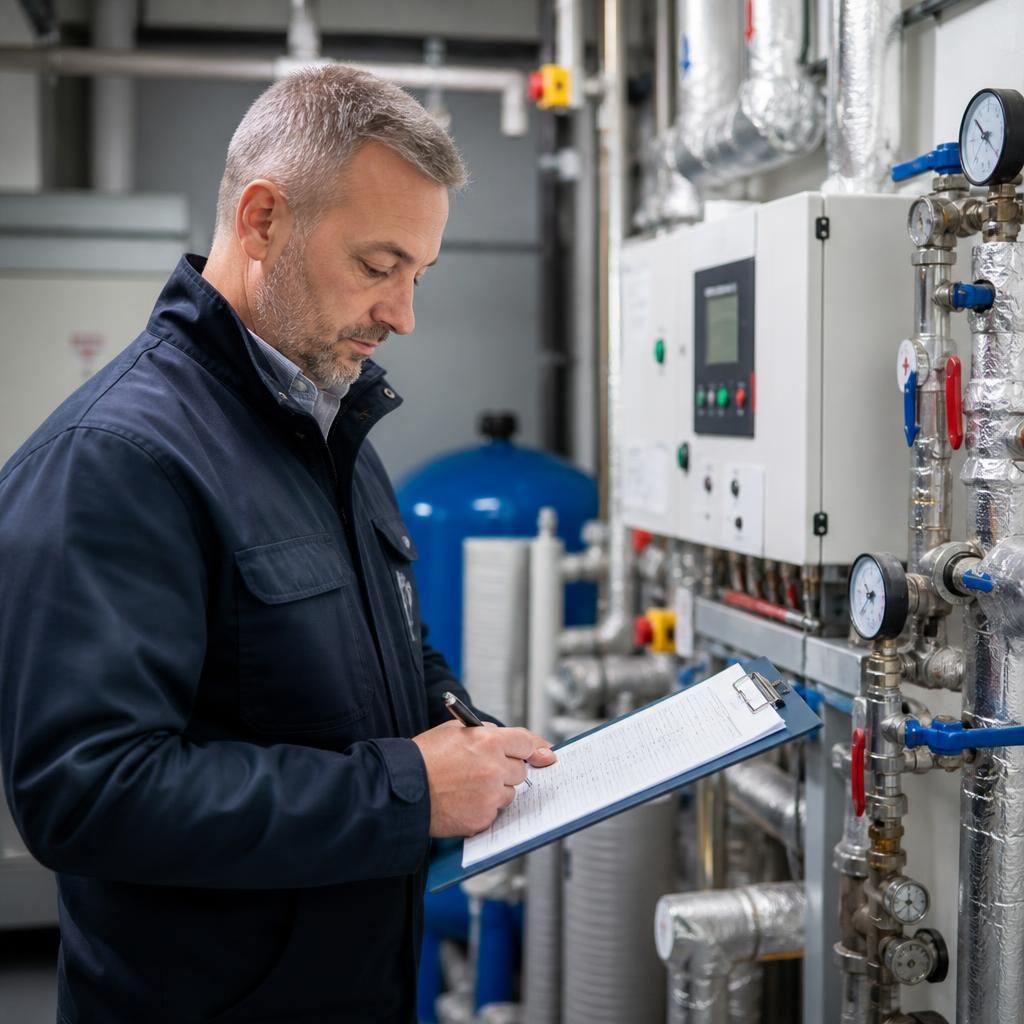
Contractor handovers are an important part of maintaining legionella compliance after an assessment. Before work begins, the contractor should receive relevant information about the water system, known hazards, access restrictions and required control measures. The work order should define the task clearly, including any cleaning, disinfection, equipment replacement or alteration to pipework.
After completion, the organisation should obtain suitable evidence of what was done, which assets were affected and whether any follow-up checks are needed. This information should be considered alongside the existing water safety arrangements so that maintenance does not introduce new stagnation points, change operating conditions or leave parts of the system outside the documented control scheme.
Need help maintaining legionella compliance after an assessment?
If you need to check that your post-assessment arrangements remain suitable, contact Blue Fish Water Management to discuss a practical review of your legionella control and compliance requirements.